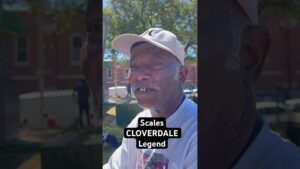




The West Baltimore native became one of Bucknell University’s greatest basketball players, reached the doorstep of the NBA and discovered that a full life would require him to go beyond the game.
(BALTIMORE – August 4, 2026) – Al Leslie shows up.
That may sound like a simple statement, but the older I get, the more I understand how much it means.
He shows up for Baltimore basketball. He shows up for Greg Branch’s Legends Tournament. He shows up for the people who remember him—and for those of us still discovering exactly who he is.
That is how this story began for me.
Approximately seven years ago, I was at Greg Branch’s Legends Tournament at the Dome when somebody pointed toward a man and said, “That’s Al Leslie.”
I knew Lisa Leslie, the four-time Olympic gold medalist and one of the greatest women’s basketball players of all time.
But I did not know Al Leslie.
Nor did I know that Lisa Leslie is his younger sister—the youngest daughter of their father, Walter Leslie Sr.
Once you look at them together, the family resemblance is difficult to miss.
I knew Lisa Leslie from television. I had no idea that her basketball lineage included an older brother from West Baltimore who became one of the greatest players in Bucknell University history.
Once again, the name arrived before the story.
Years later, Al Leslie was still showing up. Now, I finally had an opportunity to ask the questions I should have asked a long time ago.
Welcome to Legends of Baltimore: Beyond the Game.
Druid Hill Avenue and Laurens Street
Leslie grew up around Druid Hill Avenue and Laurens Street in West Baltimore.
His basketball foundation was built on the city’s courts, particularly Cloverdale—the legendary outdoor basketball complex that became a proving ground for generations of Baltimore players.
His father, Walter Leslie Sr., was among the men who helped establish Cloverdale’s celebrated Sunday basketball runs. Those games were about far more than recreation. They became a Baltimore institution, attracting serious players, passionate spectators and some of the city’s most respected basketball names.
For Leslie, basketball was part of the family and part of the neighborhood.
Before college recruiters, professional scouts and NBA dreams, there were Baltimore blacktops. There were older players watching. There were neighborhood reputations to protect.
In Baltimore basketball, nobody simply handed you respect.
You had to earn it.
Cloverdale provided more than a place to play. It created a culture. Young players could watch older players, learn the game and measure themselves against some of the best competition in the city.
The Sunday runs brought people together. The court became a gathering place, a classroom, a proving ground and, for many young men, a sanctuary.
Leslie was growing up inside a Baltimore basketball tradition that he and others did not yet realize would one day need to be preserved.
An Opportunity Through Education
Leslie attended Booker T. Washington Middle School before receiving an A Better Chance scholarship to attend McDonogh School, where he spent all four years of high school.
That scholarship changed the trajectory of his education and his life.
It took a young man from West Baltimore and placed him in a different academic, cultural and social environment. The transition required far more than basketball ability.
Who prepares a young person from Druid Hill Avenue and Laurens Street for those new rooms?
Who explains the expectations?
Who teaches him how to move between different communities without losing himself?
Who helps an athlete understand that the position he plays at one level may not be the position he will be expected to play at the next?
These are the questions that make Leslie’s story larger than statistics.
Talent may open the door, but talent alone does not teach you how to live once you walk through it.
At McDonogh, the 6-foot-3 Leslie played inside. He was talented, but he was not heavily recruited. His size did not fit the traditional expectations for a college center, and he had not yet been fully developed as a perimeter player.
Bucknell University saw something in him.
The opportunity would change Leslie’s life—and eventually change Bucknell basketball history.
Becoming a Bucknell Legend
Al Leslie did not merely have a good college career.
He became one of the greatest basketball players in Bucknell University history.
After arriving as a lightly recruited 6-foot-3 inside player, Leslie transitioned to guard and small forward.
The change unlocked his game.
A four-year starter, Leslie finished his Bucknell career with 1,973 points and an average of 18.1 points per game. He established school records for points in a game, points in a season and points in a career—all without the benefit of a three-point line.
Think about that.
Every one of Leslie’s 1,973 points came before college basketball adopted the three-point shot. Long-range baskets that would earn players three points today counted for only two during his career.
During the 1979–80 season, Leslie scored 564 points and averaged 20.9 points per game. Bucknell finished 20–7, establishing a school record for victories at the time.
That season also included one of the most meaningful moments of Leslie’s life.
On Jan. 12, 1980, Leslie scored a school-record 45 points as Bucknell defeated American University, 105–89.
His mother, Beverly Henry—whom Leslie calls “my heart”—attended only one of his games at Bucknell.
It was that game.
Of all the games she could have witnessed, she was present when her son delivered the greatest scoring performance of his college career.
She saw him score 45 points.
She saw him establish a Bucknell record.
She saw the young man who had traveled from West Baltimore to McDonogh through an A Better Chance scholarship become part of college basketball history.
Some moments seem too perfectly arranged to be accidental.
Leslie returned for his senior season and scored another 537 points, including a 41-point performance against West Chester.
He started the final 105 games of his college career and scored in double figures in all but 11 of them.
His teams established school victory records during his sophomore and junior seasons, finishing 18–7 and 20–7, respectively. Bucknell also captured consecutive East Coast Conference Western Section championships.
The individual honors followed.
Leslie was a three-time All-East Coast Conference selection. He earned First Team All-ECC honors in 1980 and 1981 and received All-America mention during his senior year.
He won Bucknell’s Kribbs Award as the team’s most valuable player three consecutive years. He also received the Christy Mathewson Award, presented to the outstanding athlete in his graduating class.
Bucknell inducted Leslie into its Athletics Hall of Fame in 1986.
His career scoring record stood for 32 years before Mike Muscala surpassed it in 2013.
In 2006, Bucknell retired Leslie’s No. 22 jersey. Leslie and Hal Danzig became the first two men’s basketball players in school history to receive that distinction.
Those numbers establish the magnitude of what Leslie accomplished.
He was not simply a Baltimore player who went away to college and did well.
He became a Bucknell legend.
The NBA Calls
After Bucknell, Leslie earned an invitation to the Portsmouth Invitational Tournament, an important showcase for senior college players hoping to attract the attention of professional teams.
He played well enough to turn the possibility of professional basketball into something real.
The Indiana Pacers selected Leslie with the 37th overall pick in the second round of the 1981 NBA Draft. He was the 14th player chosen in that round and the first Bucknell player selected in the NBA Draft.
The dream had arrived.
But Leslie soon discovered that being drafted by an NBA team and being prepared for life in the NBA were not necessarily the same thing.
When he arrived in Indiana, the Pacers attempted to move him to point guard.
Leslie had flourished at Bucknell as a guard and small forward, but becoming an NBA point guard required another level of ballhandling, decision-making and command.
He described himself as being like “a deer in headlights.”
Leslie did not yet possess the confidence or professional standing to tell the organization, “This is not my position.”
That admission matters.
Young athletes are often taught to follow instructions, respect coaches and avoid appearing difficult. Professional sports, however, also require players to understand their strengths and advocate for how they can best contribute.
Who teaches a newly drafted player how to have that conversation?
Who tells him when to remain quiet and when to speak up?
Who explains that an organization’s plan for him may not match the skills that brought him there?
Leslie tried to become the player the Pacers wanted him to be. He battled through training camp and made it to the team’s final cut before the regular season.
He had reached the doorstep of the NBA.
Then the door closed.
One Decision Away
Becoming the final cut carries a special kind of pain.
You were not miles away.
You were one decision away.
Leslie later competed in the Los Angeles Summer League, where he and his teammates committed themselves defensively and became one of the tournament’s leaders in steals.
He also received opportunities with the Washington Bullets and Philadelphia 76ers. He subsequently played for the Rochester Zeniths of the Continental Basketball Association.
Leslie had been drafted. He had survived nearly an entire NBA training camp. He had competed in summer-league basketball and received additional professional opportunities.
He had done enough to see the NBA clearly.
But the long professional career he envisioned did not materialize.
That distinction is important.
Al Leslie did not fail to become a great basketball player. His Bucknell records, honors and retired jersey settled that question a long time ago.
But even a great basketball player can experience the disappointment of watching his greatest professional dream slip away.
We Did Not Appreciate the Moment
Looking back, Leslie understands that he and other players did not always appreciate what was happening while they were living it.
Young athletes often believe another game, another season or another opportunity will always come.
They rarely recognize that a particular team, coach, tournament or collection of players may never exist in quite the same way again.
The people at Cloverdale were not merely playing basketball.
They were creating history.
The players at McDonogh were not merely competing for their school.
They were preparing themselves for opportunities most young athletes would never receive.
The young men entering major colleges and professional camps were not merely chasing careers.
They were carrying their families, neighborhoods and the reputation of Baltimore basketball with them.
But when you are young and living inside the moment, it can feel ordinary.
Only years later do you understand what was standing directly in front of you.
That is one reason documenting our legends is so important.
We cannot wait until every newspaper clipping is lost, every photograph is unidentified and every person who remembers the story is gone.
When Basketball Stops Introducing You
Basketball eventually ended, but Leslie’s life continued.
That is another truth this series must confront.
Athletes spend years being told what time to report, where to stand, what to wear and how to perform. Their identities become connected to teams, uniforms, statistics and applause.
Then, sometimes abruptly, the cheering stops.
Who are you when basketball is no longer introducing you?
Leslie entered education. He taught computer science and coached junior varsity basketball at McDonogh, returning to the institution where his own development had taken place.
He returned to Bucknell as a graduate assistant and explored opportunities to continue coaching at the collegiate level.
He also built a professional career outside basketball, including working as an insurance underwriter and later serving as a programs director at the Woodstock Job Corps Center.
Those chapters reflected an important part of Leslie’s character.
He continued moving.
The NBA dream had not unfolded as expected, but his life was not over. A basketball loss did not have to become a life sentence.
He had to discover who Al Leslie was without a scoreboard providing the answer.
Addiction, Recovery and Honesty
Leslie’s journey also included addiction and recovery.
His struggle began around 1986 and affected multiple areas of his life.
These details are not included for sensationalism.
They are part of the truth.
Too often, we celebrate athletes only when they appear invincible. We applaud the points, championships, scholarships and professional opportunities while ignoring the person attempting to carry all of it.
We see the retired jersey.
We do not always see the disappointment.
We see the name in the record book.
We do not always see the man trying to rebuild his identity after basketball.
We see the public résumé.
We do not know what is happening inside the person.
We do not know what someone may be attempting to numb. We do not know how difficult it can be to adjust when the life once imagined no longer exists.
Leslie’s willingness to discuss addiction and recovery makes his story more valuable—not less.
Survival is an accomplishment.
Recovery is an accomplishment.
Standing before people and telling the truth about where you have been is an accomplishment.
That honesty may help another athlete understand that the end of a playing career does not have to become the end of a meaningful life.
Debbie Turner and the Man He Is Today
No honest story about the man Al Leslie has become would be complete without his wife, Debbie Turner.
Leslie says Debbie has brought out the best in him.
That acknowledgment belongs in this story because Beyond the Game is not concerned solely with what a man accomplished when the crowd was watching. It is also concerned with the people who stand beside him when there is no scoreboard, no uniform and no applause.
Greatness is not developed only by coaches and teammates.
Sometimes it is nurtured by a wife who sees the best in a man and encourages him to see it in himself.
Debbie represents the life Leslie continued building after basketball. Her presence is part of his growth, his stability and his understanding of who he is today.
There is strength in recognizing the person who helped you become better.
Leslie gives that credit to Debbie Turner.
Losses Prepare You to Win
One of the strongest lessons Leslie carries today is that losses prepare us to win.
A loss is not the end of the world.
It means you have to work harder.
It means you have to learn.
It means you may have to become somebody beyond the person you originally imagined.
That lesson applies to basketball, but it also applies to education, employment, marriage, parenting, addiction, recovery and life.
Leslie experienced the disappointment of reaching the NBA without securing the career he envisioned.
He experienced professional changes, personal struggles and the closing of chapters he once believed would last.
But he kept moving.
The losses taught him.
The losses humbled him.
The losses prepared him for responsibilities that basketball alone could never have explained.
Winning is not always the trophy somebody places in your hand.
Sometimes winning means surviving long enough to understand the loss.
Sometimes winning means recovering.
Sometimes it means rebuilding your life.
Sometimes it means finding the person who brings out the best in you.
Sometimes it means returning to the place where the story began.
And sometimes it means standing before the next generation and telling them the truth.
Returning to the Dome
That is what makes Leslie’s return to Greg Branch’s Legends Tournament so meaningful.
The tournament is not merely a reunion for former basketball players.
It is a living archive.
The Dome holds names, memories, rivalries and relationships that may never be captured completely in newspaper records or online statistics.
For me, Greg Branch’s tournament became a reintroduction to the larger history of Baltimore basketball.
The names arrived before the people did.
Men I had heard about—or should have heard about—were standing directly in front of me.
The Dome was not merely hosting basketball games.
It was holding Baltimore history.
That was where I first saw Al Leslie.
Somebody pointed him out and said, “That’s Al Leslie.”
Today, I understand what that statement meant.
That was the man who scored 1,973 points at Bucknell without a three-point line.
That was the man who scored 45 points in a college game—with his mother, Beverly Henry, in attendance for the only Bucknell game she ever saw.
That was Bucknell’s first NBA Draft selection.
That was the man whose No. 22 hangs in Bucknell’s arena.
That was Lisa Leslie’s older brother.
But the man standing in front of me was carrying more than basketball statistics.
He was carrying Druid Hill Avenue and Laurens Street.
He was carrying Booker T. Washington, McDonogh, Cloverdale and Bucknell.
He was carrying the disappointment of professional basketball opportunities that did not become a lasting NBA career.
He was carrying the experience of education, employment, family, addiction and recovery.
He was carrying the love of his mother and the support of his wife, Debbie.
He was carrying his victories and his losses.
And he was still showing up.
Bringing Cloverdale Back
Leslie would like to see the spirit and energy of Cloverdale revived.
Not merely the games, but the community surrounding them.
Cloverdale represented a time when Baltimore’s playgrounds served as public gathering places. People knew the players. Children watched the older athletes. Families came out. Reputations were formed, and stories traveled across the city.
Those courts helped build confidence, discipline, relationships and identity.
They gave young people somewhere to go and someone to admire.
Reviving that spirit would require more than resurfacing a basketball court.
It would mean restoring community ownership.
It would mean connecting generations.
It would mean creating a place where older players can teach younger ones—not only how to play basketball, but how to carry themselves beyond it.
It would mean restoring the expectation that Baltimore’s young people deserve institutions worthy of their talent.
Leslie remembers what Cloverdale gave him.
Now, he wants another generation to experience something similar.
He Shows Up
Al Leslie’s story cannot be reduced to where he was drafted, how close he came to an NBA career or what happened after basketball.
His life is about persistence.
It is about adjusting when the position changes.
It is about rebuilding when the original plan fails.
It is about understanding that a loss can either bury you or teach you.
It is about honoring a mother who witnessed the game of a lifetime.
It is about recognizing a wife who brought out the best in him.
And it is about coming back home with something to offer.
When I first saw Leslie at the Dome, I did not know enough to understand the full meaning of his presence.
Now I do.
He did not have to be there.
He could have remained somewhere else, satisfied that his records, honors and retired jersey had already established his place in history.
Instead, he returned.
He came back to the people.
He came back to the tournament.
He came back to the history.
He shows up.
And in a world filled with people who disappear when the cheering stops, showing up may be one of the most legendary things a person can do.
That is what makes Al Leslie more than a former basketball player.
That is what makes his story Beyond the Game.