

When Black elected officials endorse against Black candidates in a majority-Black district, voters deserve an explanation.
“Charity starts at home.”
(RANDALLSTOWN – July 1, 2026) – There are moments in politics when elections reveal more than winners and losers.
They reveal priorities.
The Democratic primary for Baltimore County Council’s 2nd District is one of those moments.
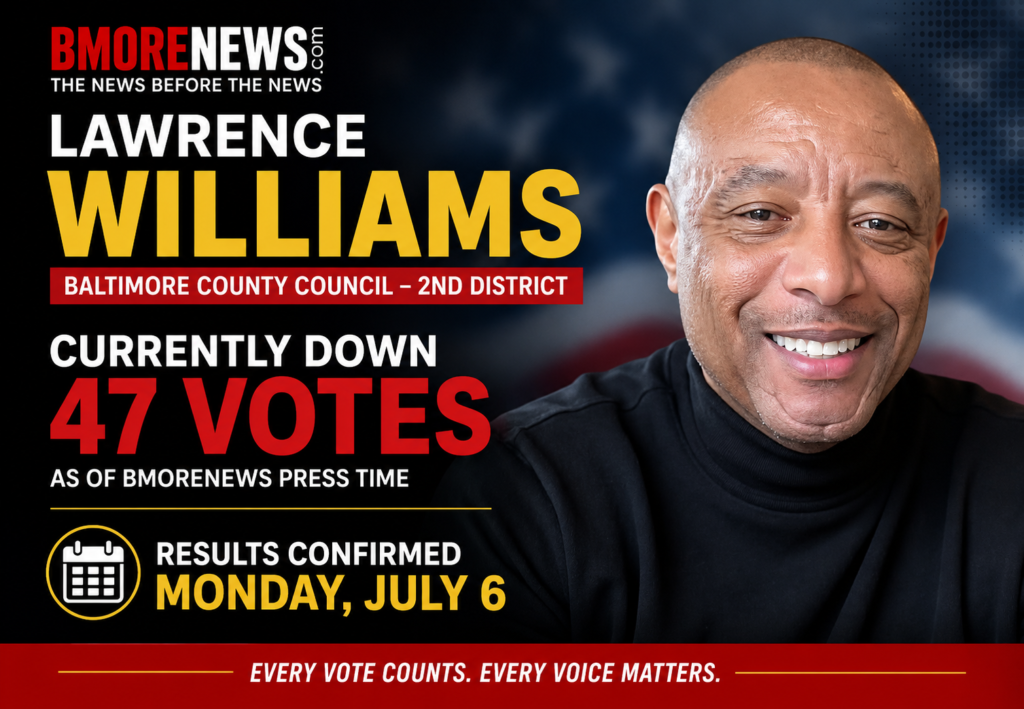
The question is no longer simply why Ruben Amaya is leading Lawrence Williams.
The larger question is this:
Why did an all-Black political leadership team representing one of Baltimore County’s largest Black populations choose to endorse against the Black candidates in the race?
That is a fair question.
It is an important question.
And it deserves an honest answer.
During a recent interview, candidate Lawrence Williams shared something that directly contradicts one of the explanations circulating in the community.
Williams said he approached Delegate N. Scott Phillips months before the election—during the fall of 2025—about receiving his support.
According to Williams, Phillips told him the legislative team would stay out of the race.
Williams says he accepted that.
Had the legislators remained neutral, there would be little to criticize.
But that isn’t what happened.
Instead, the legislative team ultimately endorsed Ruben Amaya.
If Williams’ account is accurate, then the explanation that he “never asked” simply doesn’t hold up.
That matters because Delegate Phillips is not just another legislator.
He serves as Chair of Maryland’s Legislative Black Caucus.
That position carries symbolism.
Leadership.
Responsibility.
Which raises an uncomfortable question:
How does the chair of the Legislative Black Caucus justify endorsing a non-Black candidate over two Black candidates in a majority-Black district?
That question is not about Ruben Amaya.
This is not an attack on Ruben.
He ran his campaign.
He earned votes.
Voters will ultimately decide whether he serves on the County Council.
This editorial is about the choices made by Black political leadership.
History matters.
Black political representation in Baltimore County was not handed to us.
People fought for it.
They organized.
They litigated.
They challenged maps.
They challenged systems.
Kenneth Oliver became the county’s first Black councilmember because people refused to accept permanent exclusion.
Speaker Adrienne Jones became the first Black Speaker of the Maryland House of Delegates because generations built the foundation before her.
Julian Jones became the first Black County Council Chair because others carried the torch before him.
Those victories represented more than individual success.
They represented the accumulation of Black political capital.
Political capital should never be spent casually.
Especially not in communities where Black voters remain the overwhelming majority.
This is not the first time questions have been raised.
In 2022, many community members questioned why support appeared to flow away from qualified Black candidates in another local race.
Now, in 2026, similar concerns have resurfaced.
Patterns deserve examination.
Not because diversity is undesirable.
Far from it.
Baltimore County should welcome every community willing to serve.
But every community also has the right to protect the political progress it fought generations to achieve.
No one expects Latino leaders to apologize for supporting Latino candidates.
No one expects Irish organizations to avoid supporting Irish candidates.
No one criticizes Italian civic groups for cultivating Italian leadership.
Jewish political organizations openly support Jewish candidates.
Every community invests in itself.
Why is Black political investment treated differently?
Perhaps the most striking comparison comes from Baltimore City’s 41st Legislative District.
There, many supporters stood publicly beside an indicted incumbent state senator.
Whether one agreed with that decision or not, they demonstrated loyalty.
They did not scatter.
They did not distance themselves.
They stood together.
Yet here in Baltimore County, before Election Day even arrived, influential Black elected officials lined up behind someone other than either Black candidate.
That contrast deserves reflection.
This is not about demanding blind racial loyalty.
Black candidates should still have to earn votes.
Competence matters.
Integrity matters.
Preparation matters.
But when Black political leadership repeatedly chooses not to invest in Black candidates in Black communities, voters are justified in asking why.
Politics is about choices.
Endorsements are choices.
And every endorsement communicates values.
The voters of Baltimore County deserve to know the reasoning behind those choices.
Not whispered explanations.
Not political spin.
Clear answers.
Because this discussion is larger than one council race.
It is about the future of Black political representation in Baltimore County.
If Black elected officials are unwilling to explain whom they represent and why they make the endorsements they do, voters will eventually answer that question for them at the ballot box.