

(BALTIMORE – September 7, 2026) – People who are not from here, you have nothing to fear.
Come with love in your heart, and all will be well.
From the Inner Harbor to Druid Hill Park, from Luzerne Playground all the way to the new Cahill Recreation Center, from Park Heights to Cherry Hill, and from Westport to Hollander Ridge—welcome to Baltimore.
We have some of the most delicious food you could ever sink your chops into. We have Arabbers who bring fresh fruit right to your door.
“Watermelon, red to the rind!”
That is the song they sing.
Watermelons. Cantaloupes. Fresh fruit rolling through the neighborhood as the bells jingle and the ponies pull their colorful carts down Baltimore streets on a Saturday morning.
Nearby, people are out front cleaning their steps—scrubbing and polishing until that famous Baltimore white marble shines brightly in the sunlight.
That is Baltimore.
Our city sometimes gets a tough rap. Yes, Baltimore can be a tough city, but it is more like an edge. That is the flavor here. That is the pace here. Baltimore is a no-nonsense town, but it is also a place where, if you fall down, somebody will help pick you up—no matter who you are.
There is a lot of love in Baltimore.
I know because I have seen it all across this city and throughout the surrounding region: Black, white, Asian, Middle Eastern and Latino; Muslim, Jewish, Christian, Nation of Islam, Catholic and Jehovah’s Witness.
And if you travel just beyond the city to the Amish Market in Timonium, you will find some truly great food there, too.
This is Baltimore: diverse cultures, incredible food, and great restaurants. There is room for everybody here.
So come to our city—but do not stop at the Harbor.
Explore our neighborhoods. Support our businesses. Meet our people.
Baltimore has dynamic businesses representing a wide range of industries, from hospitality, healthcare, and education to technology, cybersecurity, and artificial intelligence. The University of Maryland is helping to advance quantum science, and I can foresee Baltimore being right in the middle of that emerging economy.
Baltimore has always been an innovative town.
Think about some of the great educational institutions rooted in this region: Morgan State University and Coppin State University—both of my alma maters—along with Johns Hopkins University, the University of Maryland, the University of Baltimore, MICA, Loyola University Maryland, and Towson University.
We have excellent institutions. What we have not yet fully accomplished is connecting and harnessing all that potential as one powerful ecosystem.
Ten years ago, much of the conversation centered on biotechnology. Today, we are talking about artificial intelligence, data centers, and quantum science.
The possibilities are enormous.
The University of Maryland’s expanding presence in Baltimore adds to that promise. People are coming here. People are purchasing property here. People are investing here—all kinds of people.
Baltimore has it going on.
More Than a Basketball Game
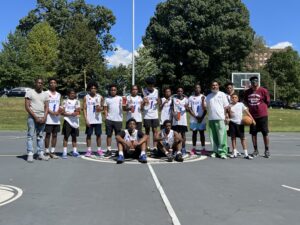
When I attend the Labor Day cookout and basketball games at Cloverdale, or the Legends Tournament at the Dome, I see another part of Baltimore that people on the outside may never fully understand.
Basketball culture is an essential part of this city.
Too often, people look at it as merely a sport. It is much more than that.
These are generations. These are stories, memories, histories, and legacies. This is information passed from one generation to another: how to navigate college, how to travel from Baltimore to Iowa, how to avoid drugs and teen pregnancy, and how to remain focused and disciplined.
It is about learning how to become your very best.
It means hours and hours of practice. It means playing in unfamiliar leagues, leaving your comfort zone and testing yourself against stronger competition.
Every true champion has one thing in common: They did more than the average person.
You do not become a legend without working for it.
I do not care who you are or where you come from. If people genuinely revere you as a basketball legend—if you were one of the baddest players to ever step on the court—then you worked at it.
You worked harder than the opposition.
I saw Coach Bob Wade drill the 1982 and 1983 Dunbar Poets. I saw firsthand what hard work looked like. It was relentless—mentally, physically, and spiritually.
When you have witnessed that level of preparation, you understand what greatness costs.
The Schools That Shaped Baltimore
We also love Baltimore County, our surrounding jurisdiction, where Julian Jones—a Dunbar Poet—is seeking to take the helm as county executive.
Back here in Baltimore City, another Dunbar Poet, Sabrina Tapp-Harper, is doing her thing as sheriff.
But we love all of our schools.
I attended Poly before Dunbar, and I know some tremendous people from Poly who continue to do great things. I also salute the Baltimore City College Black Knights.
Move the rivalry aside for a moment. Poly, City, and Dunbar are great citywide institutions. They are part of my story and the stories of generations of Baltimoreans.
You cannot talk about Poly without City, and you cannot talk about City without Poly.
That is the game.
The City–Poly football rivalry began in 1889. It is Maryland’s oldest football rivalry and one of the oldest public high school rivalries in the United States.
That is the Baltimore I know.
Eastside. Westside. Uptown. Downtown. Cherry Hill. Hollander Ridge.
We welcome you.
Come on down. Get yourself a crab cake. Have a couple of chuckles. Walk through Lexington Market. Visit our neighborhood businesses. Stop by Benedetto Haberdashery or Jody Davis Designs and pick up something nice.
Before you head back home, take a picture.
Baltimore is not perfect. No city is. But this city has heart, history, culture, intelligence, toughness, creativity, and love.
There is room for everybody in Baltimore.
Come with love in your heart, and all will be well.
Welcome to Baltimore.