

(EASTSIDE POET GARDEN – July 14, 2026) – When people think about Paul Laurence Dunbar High School, they think about championships. They think about politicians, military leaders, educators, entrepreneurs, judges, doctors, and Hall of Fame athletes. And they should.
But there’s another side of Dunbar that deserves just as much recognition—the side built on service, on community, on the understanding that leadership isn’t measured only by titles or trophies, but by how many lives you touch along the way.
There are people who are the salt of the earth. People who understand people, and understand how to bring people together. And they’re not just good at it—they’re exceptional.
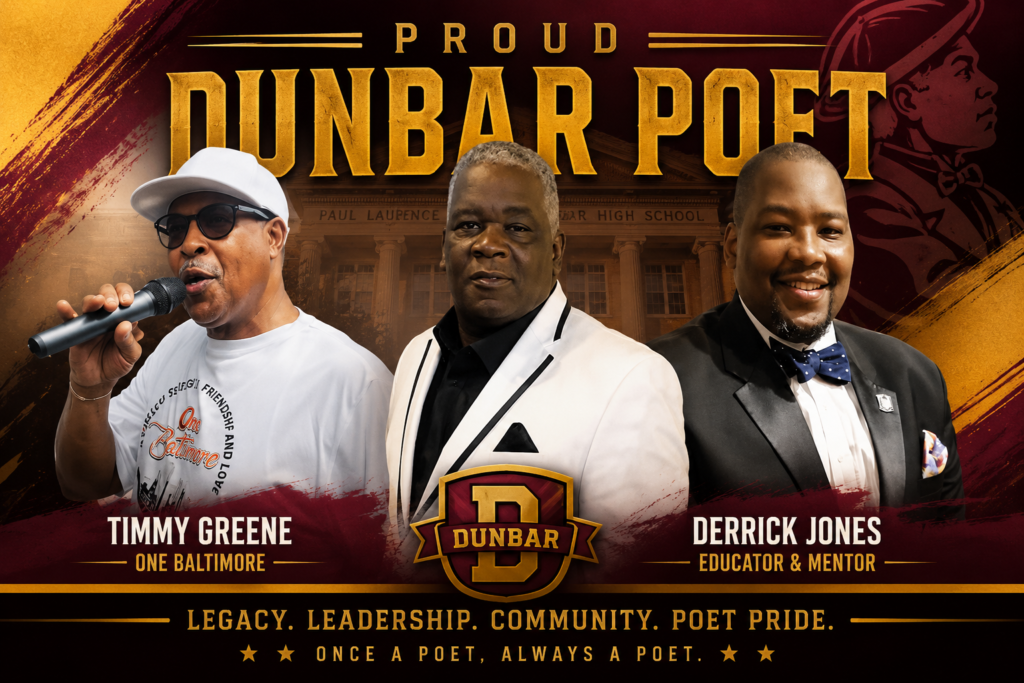
For me, three men embody that spirit: Derrick Jones, Gregory Branch, and Timmy Greene.
Derrick Jones
Derrick Jones has owned Derrick Jones Funeral Home in Park Heights for more than forty years. He played for the Dunbar Poets varsity football team in my day, and he followed in my father’s tradition—he was actually a mentee of my dad’s.
Today, Derrick serves as president of the Pleasant Yacht Club, the only Black yacht club in Greater Baltimore, and president of the Dunbar Alumni Association.
And when I tell you this man, with the help of his team, can put on an event with his people, I mean it. He is exceptional at it.
What stands out most is how he treats the seniors. In return, the teach him what us youngsters never can.
Derrick has a rapport with the senior Dunbar alumni like nobody else I’ve seen. He makes sure they’re seen, appreciated, and celebrated. That’s not just event planning.
That’s stewardship.
That’s leadership.
That’s a man with a heart of gold who understands what it means to serve his community, and he makes Dunbar proud every time.
Gregory Branch
Then there’s Gregory Branch.
Around Baltimore, people simply know him as Mr. Dunbar.
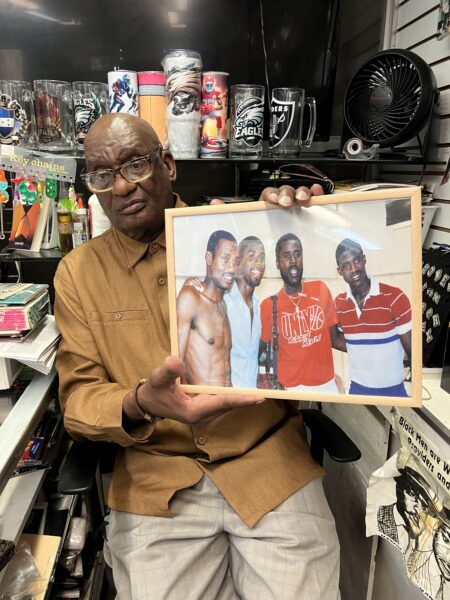
Walk into his store on Lakewood Avenue and you’ll find the finest Dunbar gear anywhere—sweaters, hats, jerseys, jackets, sweats, you name it.
But Greg’s contribution goes well beyond apparel.
Every summer he presents Legends at the Dome, coming up again on August 1st, and it is a don’t-miss event.
It’s more than a reunion.
It’s more than basketball.
It’s a celebration of Dunbar’s history and the generations who built its reputation.
Greg has become one of the school’s greatest ambassadors, proudly carrying the maroon and gold wherever he goes. The work he does taking Dunbar’s name into the community deserves to be revered and respected.
Timmy Greene
I’ve only gotten to know Timmy Greene over the past couple of years, but I’ve come to appreciate what he means to this city.
Along with founder Donnie Joy and a dedicated team, Timmy helps organize the 1 Baltimore Cookout.
Calling it a cookout really undersells it.
It’s a basketball extravaganza.
Legends.
Former players.
Coaches.
Families.
Young athletes.
People from every neighborhood.
People from every school.
People from every walk of life.
All brought together by a shared love of Baltimore basketball.
Last summer I attended for the first time, and it turned into one of the most meaningful reporting experiences I’ve had in years.
After nearly twenty years of trying, the organizers finally convinced Baltimore basketball legend Joseph Lawrence “Jo Jo” Parker to attend.
Because Timmy and his team made that happen, I had the opportunity to meet Jo Jo Parker, interview him, and later speak with him again by telephone.
Jo Jo Parker was born the fourth of seven children to the late James and Lucy Parker on October 6, 1940.
I won’t tell his entire story here, but I will tell you enough to understand why preserving these stories matters.
Over the course of his basketball journey, Jo Jo developed relationships with legends like Gus Johnson, Earl Monroe, Phil Chenier, and Wes Unseld. He played with the Harlem Astronauts and the Harlem Magicians, both extensions of the Harlem Globetrotters. While living in New York, he joined the National Guard and played on his unit’s basketball team. Then, in 1972, he became manager of The Persuaders, the legendary R&B group whose million-selling hit, Thin Line Between Love and Hate, became an American classic.
That’s the kind of history you learn at the 1 Baltimore Cookout.
As a Black journalist from Baltimore, I was able to give one of our city’s basketball legends his flowers while he was still here to receive them.
Not long afterward, he passed away.
I’ve thought about that often.
Had it not been for Timmy Greene and the 1 Baltimore Cookout, that interview never happens.
That conversation never takes place.
Those memories are never preserved from the perspective of a Baltimore Black journalist.
That’s the value of people like Timmy Greene.
They don’t simply organize events.
They create moments that preserve our history.
The work that Derrick, Greg, and Timmy do comes straight from the heart.
And that, to me, is part of what it means to be a Dunbar Poet.
The Father Figure
As much as I admire Derrick Jones, Gregory Branch, and Timmy Greene, I’d be remiss if I didn’t acknowledge the man who helped shape so many of us in the first place:
Coach Bob Wade.
I should say up front that I wasn’t one of Coach Wade’s basketball players. I played JV football and tried out for varsity, but my senior year took a different turn. After getting into trouble, football was no longer an option. So, I ran varsity cross country, varsity wrestling, and varsity baseball. I also served as co-captain of the wrestling team my senior year.
The wrestling room sat just off Dunbar’s gym.
Day after day, we’d hear Coach Wade’s booming voice echo through that building.
We’d watch those basketball players running suicide drills, weaving through figure-eight drills, practicing until they had absolutely nothing left.
You didn’t have to wear his uniform to feel his presence.
You didn’t have to play basketball for Coach Wade to understand his impact.
There’s simply no way to celebrate Derrick Jones, Gregory Branch, and Timmy Greene without recognizing the man whose influence helped define the Dunbar spirit.
To generations of Dunbar Poets, Coach Wade was far more than a basketball coach.
He was—and still is—a father figure.
Every year, without fail, Coach Wade calls me on my birthday.
Every year.
I try to remember his birthday, too, but I’ll be honest—he remembers mine better than I remember his.
That’s who he is.
Decades later, he’s still checking on us.
Still encouraging us.
Still reminding us that we’re part of something bigger than ourselves.
And I’m not unique.
Ask Muggsy Bogues.
Ask the countless former players who still call him “Coach.”
Many of them love him like a father because that’s exactly what he became.
Coach Wade understood Baltimore’s young Black men as well as anyone I’ve ever known.
If there was ever a specialist in saving young Black boys, it was Coach Bob Wade.
One of the things he did was employ his players at his liquor store.
Think about that.
A ninth grader.
A tenth grader.
An eleventh grader.
A twelfth grader.
Earning an honest paycheck.
Learning responsibility.
Building confidence.
Having money they earned—not money handed to them.
Coach Wade understood that discipline on the basketball court had to connect to opportunity off the court.
Otherwise, the lessons wouldn’t stick.
People talked about how demanding his practices were, and they were.
But there was purpose behind every drill.
His philosophy was simple.
If he worked young men hard enough, they’d go home, eat dinner, and go to sleep instead of running the streets.
He wasn’t simply coaching basketball.
He was channeling energy.
He was building discipline.
He was building character.
He was building men.
The championships mattered.
But I believe his greatest victories were measured by the lives he helped shape.
The Village
Coach Wade wasn’t alone in that mission.
Coach John Murdoch was an extension of that same spirit of service.
I’ll tell you this.
When I posted a video of Coach Murdoch, thousands upon thousands of people watched it.
People love Coach John Murdoch.
He was part of the Dunbar family.
He was East Baltimore.
To my knowledge, Coach Murdoch checked on students all over the Eastside.
And he did much of it without a car.
Think about that kind of commitment.
If you wanted to play basketball for Coach Murdoch, you had to go to school.
There were no shortcuts.
He checked on your grades.
He checked on your family.
He understood that coaching wasn’t really about basketball.
It was about the whole young man standing in front of him.
That’s the same championship culture that produced legends like Muggsy Bogues, Dwayne “Kosher” Wood, and so many others whose impact continues to be felt throughout Baltimore today.
More Than Championships
When people think about Dunbar, they think about banners hanging from the rafters.
They think about famous alumni.
They think about championships.
Those things matter.
But they aren’t the whole story.
The real story is service.
The real story is community.
The real story is people who dedicate themselves to lifting others.
Derrick Jones.
Gregory Branch.
Timmy Greene.
Coach Bob Wade.
Coach John Murdoch.
And so many others.
They remind us that being a Dunbar Poet was never just about personal achievement.
It’s about making sure the next generation has an opportunity to succeed.
It’s about preserving history.
It’s about honoring elders.
It’s about serving your community with humility, discipline, and heart.
The banners hanging inside Dunbar tell the story of championships.
The people I’ve written about tell the story of why those championships mattered.
That’s the Dunbar tradition.
That’s the maroon and gold.
And that’s why, when I think about these men—and the countless teachers, coaches, mentors, and alumni who have carried this legacy forward—I can say with pride:
Go Dunbar.
Go, Poets! Go!