




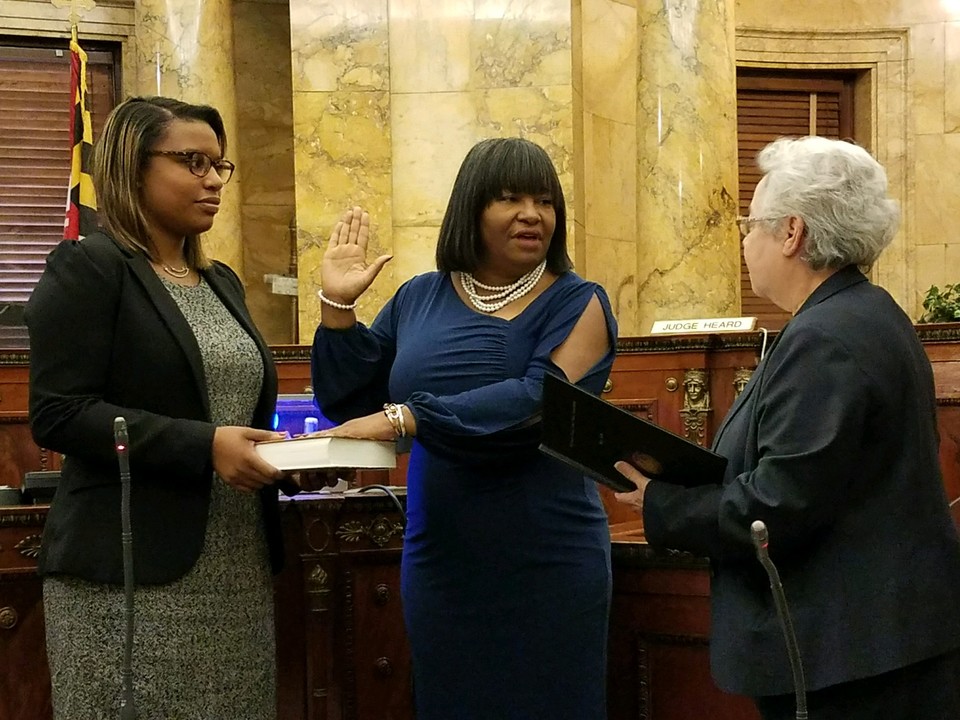
Daughter of education pioneer Dr. Sterling Keyes, the retired Baltimore jurist redefines justice through accountability, presence, and an unshakable belief in people.
(BALTIMORE – July 2, 2026) – Judge Wanda Heard does not believe justice ends at sentencing.
For her, probation is not paperwork.
It is a promise.
“I put them on probation,” she says. “That’s my responsibility. I sentenced them. I signed the probation papers. Why am I not responsible to the person who’s on probation just like they’re responsible to me to do what they’re told?”
That philosophy sets her apart.
Inside her courtroom, there are rules. Structure. Order. Accountability.
But what makes Judge Heard different is what happens after people leave.
She follows up.
She listens.
And when necessary, she shows up.
When probationers begin telling her troubling stories about treatment facilities—poor conditions, questionable oversight—she does not rely on reports.
“I’d get in my car and drive over there,” she says. “I’d knock on the door and tell them I wanted a tour.”
Not scheduled.
Not staged.
“I don’t want you to fix up nothing,” she says. “I want to see what it looks like on a regular day. You’ve got some of my people in here. I want to know where they’re living and how they’re being treated.”
Some call that unusual for a judge.
She calls it doing her job.
“People would say, ‘You’re being a social worker,'” she recalls. “I said, ‘I’m just trying to do my job.'”
One visit becomes unforgettable.
A treatment facility contacts her about a probationer threatening staff. Instead of immediately issuing a warrant, Judge Heard gets in her car and drives there herself.
She walks inside and asks one question.
“Where is he?”
When the young man arrives, she immediately recognizes the attitude he has brought with him.
“So what are we doing?” she asks. “Are we doing Gaudenzia’s treatment program—or are we doing yours?”
The message is unmistakable.
“I sent you here,” she tells him. “You would be in jail, but you’re here. You’re not running this program.”
The young man admits he never expected the judge to come.
Her answer says everything.
“Why do you think I put you here?”
She gives him a choice.
Participate.
Respect the program.
Or go to jail.
He apologizes.
According to the treatment staff, the change spreads throughout the facility.
“They told me they never had another problem,” Judge Heard says. “Everybody participated after that.”
For Judge Heard, this is never about intimidation.
It is about accountability.
“They needed to understand the ground rules,” she says. “There are consequences.”
Then she adds with characteristic candor:
“I’m not your mother. I’ve got a bigger hammer. Jail is the hammer.”
That balance—firmness without cruelty, compassion without surrender—defines her career.
It also begins at home.
Judge Heard is the daughter of Dr. Sterling Keyes, the first African American superintendent of Baltimore City Public Schools.
“My dad was the man,” she says.
Her admiration for her father is unmistakable.
More than anyone else, he shapes the philosophy that guides her life and, ultimately, her courtroom.
“My father told me every child can learn,” she says. “Every child should have dreams, and those dreams should be supported.”
Those words become the foundation of everything that follows.
Recalling Baltimore’s struggle to integrate its public schools, Judge Heard reflects on her father’s work creating new educational opportunities for children across the city.
“That was my father who did that,” she says.
The connection between father and daughter is unmistakable.
He devotes his life to opening doors through education.
She devotes hers to opening doors through justice.
He believes schools can change lives.
She believes accountability, compassion, and second chances can change lives.
Where he sees students with limitless potential, she sees defendants whose futures do not have to be defined by their worst decisions.
That conviction shapes every decision she makes on the bench.
Where others see defendants, Judge Heard sees people still in progress.
Where others see violations, she sees choices—and the opportunity to make better ones.
One story illustrates that philosophy perfectly.
Two young men appear before Judge Heard on drug charges. She places them on probation and gives them one clear instruction: stay away from a particular drug corner.
Soon afterward, someone sends her a rap video.
The two young men proudly proclaim they are “the biggest drug dealers in the world.” They flash drugs, guns, and—of all places—the very corner Judge Heard has ordered them to avoid.
She immediately calls their attorney.
“Tell your clients to come to my courtroom.”
When they arrive, their heads are bowed.
“What were you thinking?” she asks.
She has every legal right to send both of them to prison.
Instead, she sees something deeper.
The friendship itself has become part of the problem.
“I need you to say goodbye to each other.”
She adds a new condition of probation.
No contact.
No hanging out.
No phone calls.
No spending time together.
One young man changes.
He goes back to school.
He gets a job.
He follows every condition the court imposes.
Eventually, Judge Heard rewards that work by giving him a disposition that allows him to move beyond a felony conviction.
The other continues making poor choices.
Eventually, he goes to prison.
Same courtroom.
Same judge.
Same opportunity.
Different decisions.
Different outcomes.
Judge Heard never confuses compassion with permissiveness.
She imposes curfews.
She demands accountability.
She involves families.
“I’d tell them if I called five minutes after midnight, they’d better be home.”
Most of the time, she never has to make the call.
Grandmothers call.
Mothers call.
Fathers call.
Families become partners in rehabilitation.
When someone violates the court’s trust, Judge Heard responds.
Not emotionally.
Not impulsively.
But consistently.
“I keep my promise,” she says.
That consistency earns respect.
Sometimes, it changes lives.
Judge Heard understands Baltimore.
Though she is not a native, she understands this city as well as many who are. She knows the neighborhoods. She knows the drug corners. She has watched the videos glorifying violence and drug dealing. She understands the forces that shape lives, but she also understands the choices people make within those circumstances.
She knows the statistics.
Black men remain dramatically overrepresented in America’s prisons.
She refuses to ignore that reality.
Neither does she excuse criminal behavior.
Instead, she insists on something that has become increasingly rare: accountability joined with hope.
As I listened to Judge Heard, I found myself reflecting on the thousands of people I have interviewed over the years.
She is different.
Not because she is a judge.
Because she is an exceptional human being.
She possesses a rare emotional intelligence.
She understands people long before they appear before her bench.
She understands that many never experience the kind of stable, loving home she enjoys growing up. She recognizes broken systems without surrendering to them. She sees poor decisions without reducing people to those decisions.
Most of all, she believes in human potential.
Near the end of our conversation, I ask her a simple question.
“Why do you care?”
Her answer comes without hesitation.
“My father told me that every child can learn. Every child deserves a loving family. Every child deserves dreams.”
Then she says something I will never forget.
“We don’t know who they’re supposed to be.”
That may be the most important lesson Judge Wanda Heard has to offer.
We do not know who a struggling teenager will become.
We do not know which child will grow into an entrepreneur, a teacher, a scientist, a pastor, or a community leader.
We simply do not know.
But Judge Heard refuses to give up before that story is written.
Toward the end of her career, she grows tired.
Not of people.
Of misunderstanding.
Of hearing judges blamed for laws they do not write.
Of being criticized for explaining the justice system to the public.
Yet she never grows tired of believing in people.
Reflecting on more than 40 years in the law and 21 years on the bench, she summarizes her life’s work with remarkable simplicity.
“That’s me,” she says. “I stood in that place. That was my career. That’s what I did.”
She does not seek recognition.
She probably would not ask for this story.
But it deserves to be written.
Because Judge Wanda Heard reminds us that justice is not measured only by sentences imposed.
It is measured by lives changed.
She does not simply issue orders.
She follows through.
She gets in the car.
She walks through the door.
She shows up.
And for countless Baltimoreans, that has made all the difference.