




(BALTIMORE – June 8, 2026) – Three days after Christmas 2022, Sabrina Tapp-Harper received something no veteran law enforcement officer expects after 36 years of service: a termination letter.
Imagine it.
The holidays are ending. A new year is around the corner. You’re looking ahead with optimism, reflecting on a career spent protecting others.
Then comes the news that changes everything.
For Tapp-Harper, a decorated law enforcement executive with decades of experience and no known disciplinary record during her eight years with the Baltimore City Sheriff’s Office, that moment was more than a job loss. She says it was the beginning of a campaign of retaliation that ultimately led to a federal lawsuit.
Today, she is running against the man who fired her: Baltimore City Sheriff Sam Cogen.
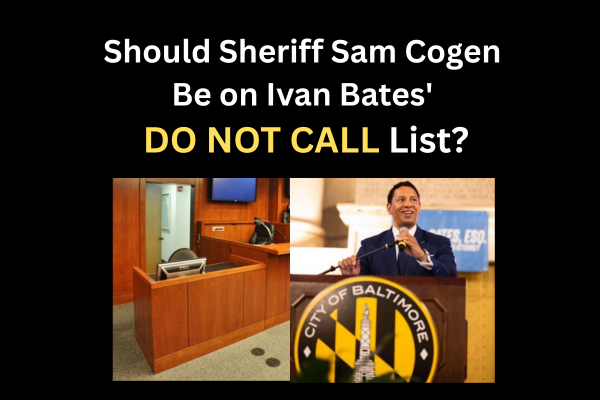
And as Baltimore City State’s Attorney Ivan Bates expands his office’s review of law enforcement credibility issues to include the Sheriff’s Office, a larger question emerges:
If credibility is the standard, should Sam Cogen himself be under scrutiny?
What Is a Do Not Call List?
A Do Not Call list identifies law enforcement officers whose credibility issues make them unsuitable witnesses in criminal prosecutions. Prosecutors maintain such lists because a witness whose truthfulness is in question can jeopardize an entire case.
The concept is simple: if a prosecutor cannot trust an officer’s testimony, that officer becomes a liability in court.
With the Sheriff’s Office now under review, voters have every right to examine the record of the man who leads it.
The Freddie Gray Question


One of the most consequential episodes in Baltimore’s recent history remains the prosecution of the six officers charged in the death of Freddie Gray.
At the time, Sam Cogen served as a Major with the Baltimore City Sheriff’s Office.
Cogen signed charging documents against the officers. His signature, under penalty of perjury, represented that an investigation had been conducted.
Later, in federal court filings, Cogen stated he had “no involvement in the investigation whatsoever,” asserting that the facts and conclusions came from the State’s Attorney’s Office and that he merely signed the documents presented to him.
A federal judge subsequently allowed claims including malicious prosecution, defamation, and invasion of privacy to proceed against him.
The legal proceedings speak for themselves.
The unanswered public question remains:
What investigation did Sam Cogen personally conduct before signing documents that helped launch one of the most controversial prosecutions in Baltimore history?
Baltimore deserves an answer.
Three Days After Christmas
Tapp-Harper brought 36 years of law enforcement experience to the profession.
A graduate of Dunbar High School, Coppin State University, and Johns Hopkins University, she spent 26 years with the Baltimore Police Department, rising to the rank of Major.
She became the first Black commander of the Northern District and the first woman to lead Special Investigations.
Her responsibilities included oversight of sex offenses, child abuse investigations, missing persons, family crimes, arson investigations, executive protection, and the sex offender registry.
She was invited to the White House to participate in discussions surrounding the Violence Against Women Act.
After retiring from BPD, she joined the Sheriff’s Office in 2014.
By her account, she accumulated eight years of service without disciplinary issues.
Then came a suspension.
Then came termination.
Three days after Christmas.
But critics argue the story did not end there.
According to Tapp-Harper and her supporters, efforts were made to notify the Maryland Police and Correctional Training Commissions of her termination, a move that could have jeopardized future law enforcement employment opportunities.
To them, this was not simply a firing.
It was an attempt to end a career.
Tapp-Harper later filed a federal lawsuit alleging retaliation.
Today, she is challenging Cogen for sheriff.
The Leadership Question
The criticism of Cogen is not limited to one former employee.
Deputies represented by FOP Lodge 22 took the extraordinary step of issuing a formal vote of no confidence in his leadership.
The deputies cited concerns involving leadership, retaliation, workplace culture, and morale.
That matters.
When criticism comes from political opponents, voters can dismiss it as politics.
When criticism comes from the people who work under a leader every day, it becomes harder to ignore.
If the deputies responsible for carrying out the Sheriff’s Office’s mission have publicly expressed a lack of confidence in its leadership, voters should take notice.
A Question of Standards
Critics have also pointed to what they view as inconsistent disciplinary standards within the Sheriff’s Office.
Supporters of Tapp-Harper note that a veteran law enforcement official with decades of service and no known disciplinary record was terminated, while deputies with documented DUI-related legal issues allegedly remained employed.
Whether voters agree with that criticism or not, it raises a broader question about judgment, consistency, and accountability.
Why was a veteran executive shown the door while others accused of conduct that could undermine public confidence kept their jobs?
That question has fueled criticism of Cogen’s leadership throughout this campaign.
Public trust depends on standards being applied fairly and uniformly.
If discipline is reserved for some but not others, confidence in leadership inevitably suffers.
Why Sabrina Tapp-Harper Says She’s Running
When asked why she entered the race, Tapp-Harper has consistently pointed to her qualifications rather than her grievances.
“I decided to run for sheriff because I had the background and the experience and the credentials to assist Baltimore in making the citizens safe,” she said. “That’s why I’m ready for sheriff.”
The contrast between the incumbent and the challenger is now before the voters.
The Verdict
This election is ultimately about credibility.
The Freddie Gray controversy.
The termination of a 36-year law enforcement veteran.
The allegations of retaliation.
The questions surrounding efforts to damage her future career prospects.
The vote of no confidence from his own deputies.
The accusations of double standards involving discipline and accountability.
These are not rumors.
These are matters of public record, public debate, and public concern.
Ivan Bates’ office is reviewing the Sheriff’s Office.
On June 23, Baltimore voters will review the sheriff.
And unlike a Do Not Call list, their decision cannot be appealed.
They will render the final verdict.
____________________________________
RELATED STORY
The People Who Work for Sam Cogen Just Told Baltimore Everything It Needs to Know