


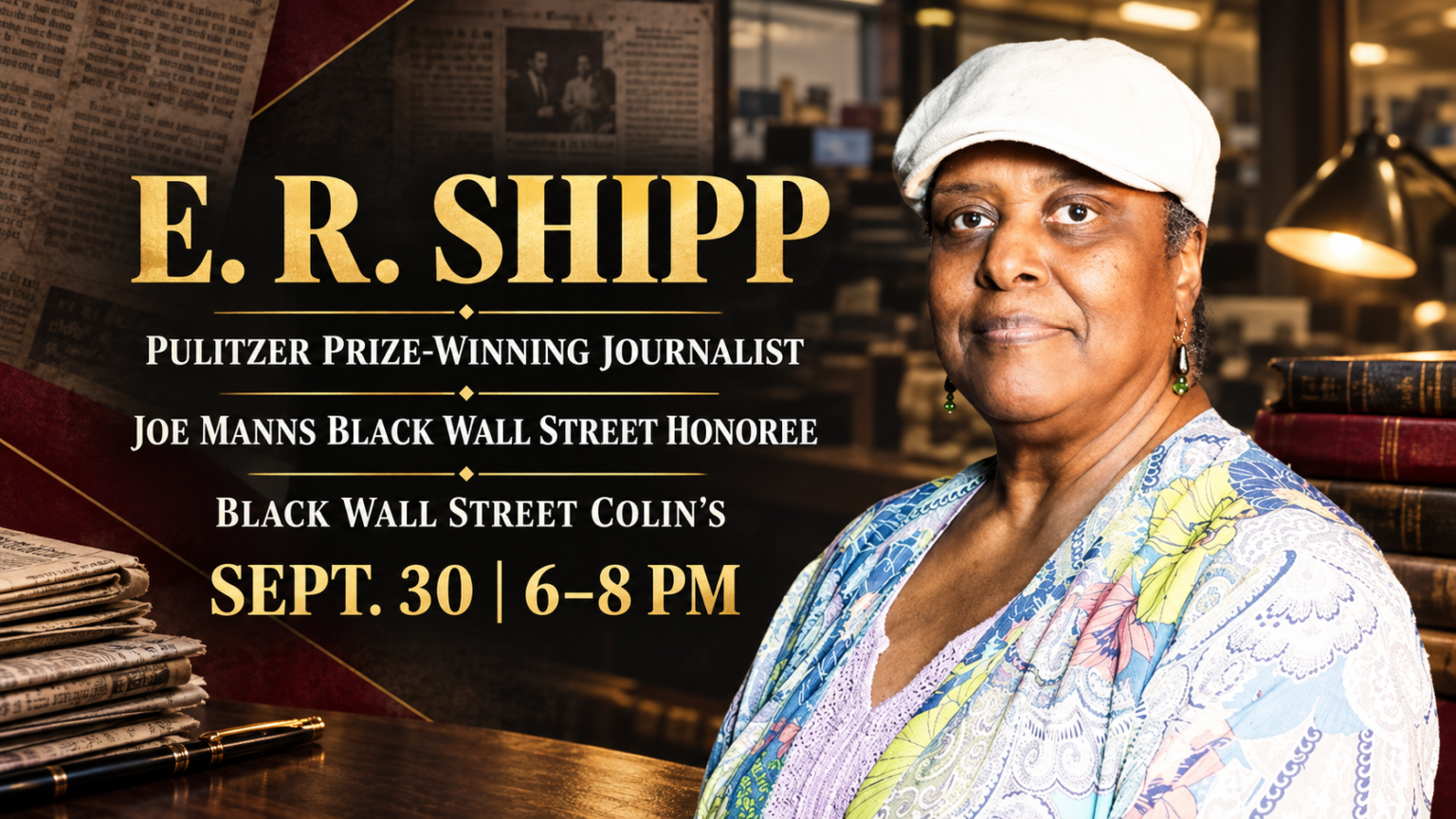
(BALTIMORE – September 15, 2026) – Our next honoree needs little introduction, especially if you come from the world of journalism, literature, or higher education.
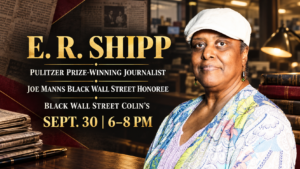
E. R. Shipp is a Pulitzer Prize-winning journalist, scholar, and professor whose career has taken her into some of the most respected newsrooms in America. Today, she helps prepare the next generation of storytellers at Morgan State University’s School of Global Journalism and Communication.
Professor Shipp will be honored with a Joe Manns Black Wall Street Award on Wednesday, Sept. 30, from 6 to 8 p.m. at Black Wall Street COLIN’S.
Born in Conyers, Georgia, Shipp earned her bachelor’s degree in journalism from Georgia State University before continuing her education at Columbia University. She holds a master’s degree in journalism, a master’s degree in history, and a law degree from Columbia.
Her journalism career has included The New York Times, The New York Daily News and The Washington Post.
Shipp joined The New York Times as a reporter in 1980. She later served as the newspaper’s Chicago correspondent, covering education, politics, and other major issues before returning to New York to focus primarily on legal affairs. She eventually became an editor at the Times.
In 1994, she began writing a column for the New York Daily News. Her commentary on affirmative action, the O.J. Simpson murder trial, the Million Man March, and other controversial subjects earned her the 1996 Pulitzer Prize for Commentary.
With that honor, Shipp became the first Black woman to receive the Pulitzer Prize in that category.
She later became the first Black person to serve as ombudsman for The Washington Post, placing her in a critical position to examine the newspaper’s journalistic practices and its relationship with the public.
Her body of work represents the highest levels of journalism, but Professor Shipp has never kept that knowledge confined to elite newsrooms.
She brought it to Morgan State University.
As a founding faculty member of the School of Global Journalism and Communication, she teaches multimedia journalism in the spirit of Sankofa—preparing students to tell stories in whatever forms the future may require while keeping them rooted in the traditions, ethics, and values that have long sustained the profession.
She teaches students about interviewing, research, opinion writing, legal affairs reporting, community-based journalism, and Black media. Her scholarly interests include the whitewashing of history, genealogy, and the lives of Black people in Southern communities during the Great Migration of millions of African Americans to points north and west.
Professor Shipp also continues to practice the craft she teaches. She writes a biweekly column for The Baltimore Banner, contributes to Black publications, and offers commentary on public radio, including Morgan State University’s WEAA 88.9 FM.
On a personal note, I appreciate that Professor Shipp gives her students an opportunity to examine the media world through the lens of BMORENews.com.
That matters to me.
Students need exposure to major legacy institutions, but they should also understand the role of independent Black media. They need to see how community-based platforms document stories that larger outlets may miss, build trust with their audiences, and survive in a rapidly changing digital environment.
For nearly a quarter-century, BMORENews.com has covered Baltimore, politics, Black business, education, and the people whose stories do not always receive the attention they deserve.
By bringing BMORENews.com into her classroom, Professor Shipp tells her students that our work is worth studying. She allows them to consider not only how journalism is practiced inside the nation’s largest institutions, but also how it is practiced from within the community.
I do not take that recognition lightly.
E. R. Shipp has already earned one of journalism’s greatest honors. Yet she continues to teach, write, question, and prepare young journalists to carry the work forward.
She understands that journalism is more than a profession. It is a public trust. It is a means of challenging power, preserving history, and making sure our communities are neither ignored nor erased.
For her historic achievements, her commitment to Black media, and her continued investment in the next generation of journalists, we are proud to recognize Professor E. R. Shipp as a Joe Manns Black Wall Street honoree.