



Long Time Comin’—But Change Is Finally Here
Sandtown-Winchester is doing something I have never witnessed before: driving its own transformation
(SANDTOWN, MD – August 27, 2026) – After years of waiting, organizing, praying, and refusing to be ignored, Sandtown-Winchester may finally be getting the blessing it deserves.
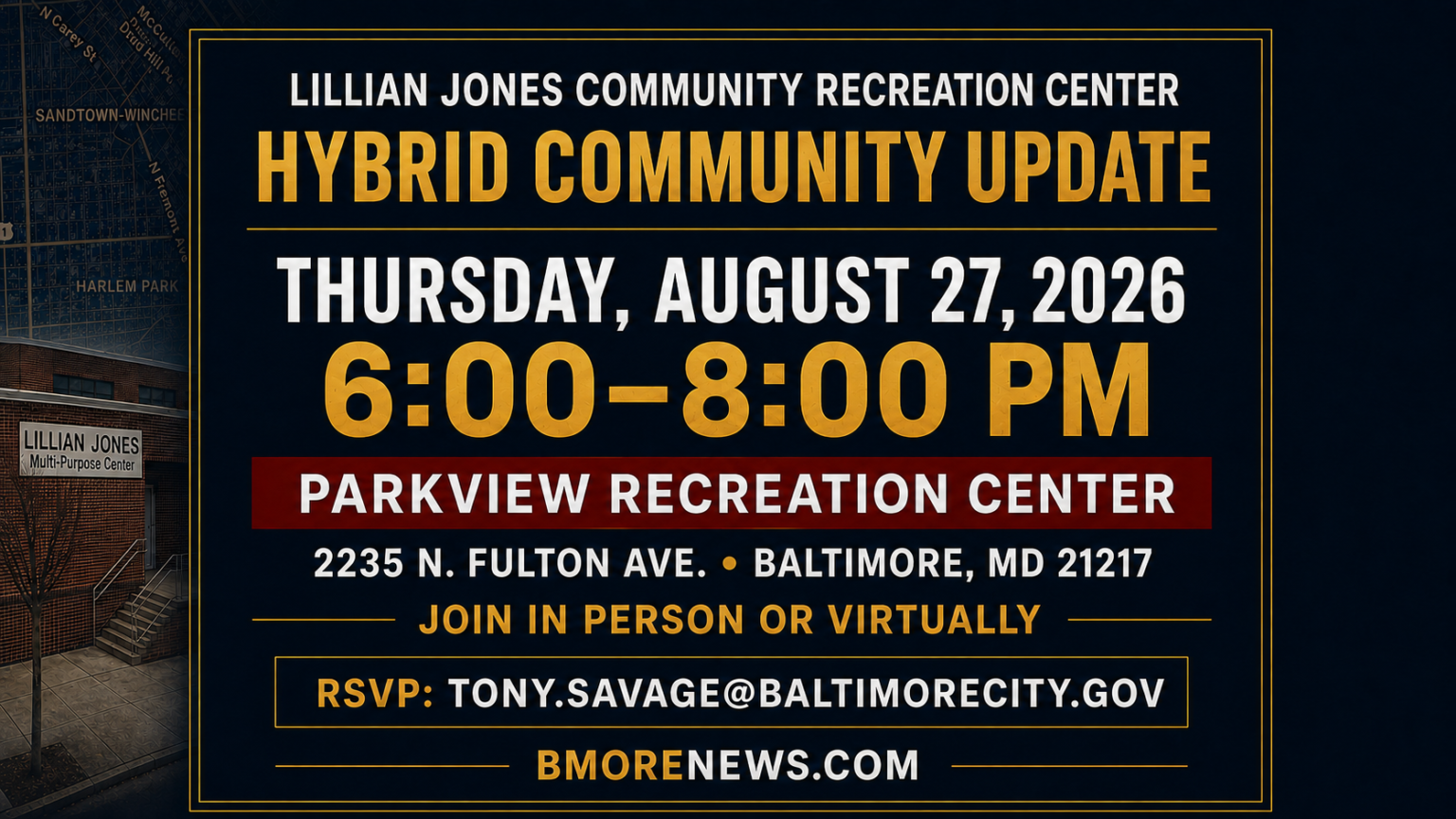
Baltimore City Recreation and Parks’ Capital Division will host a hybrid community meeting tonight, Thursday, August 27, 2026, to present updates and gather feedback on plans for the new Lillian Jones Community Recreation Center, outdoor pool and park.
The meeting will be held from 6 to 8 p.m. at the new, state-of-the-art Parkview Recreation Center, located at 2235 N. Fulton Avenue in Baltimore.
Residents who cannot attend in person may participate virtually through the Zoom link or by scanning the QR code on the meeting flyer.
Community members are asked to email Tony Savage at tony.savage@baltimorecity.gov and indicate whether they plan to attend in person or virtually.
The meeting will give residents a firsthand look at the quality and type of recreation center that can be developed for Sandtown-Winchester. Participants will receive design and planning updates, ask questions and provide feedback on a public facility intended to serve the community and surrounding neighborhoods for decades.
This is not just another meeting.
For Sandtown-Winchester, it represents a moment residents have been working toward for years.
A Community Without a Place to Gather
Sandtown-Winchester has been fighting a community-space crisis for nearly two decades.
In 2007, residents lost an important gathering place at 1114 N. Mount Street. The building, once associated with the old Coppin campus and later used as a community center, now houses Sarah’s Hope, a shelter serving families experiencing homelessness.
That loss was unrelated to the Lillian Jones Recreation Center. But it left Sandtown-Winchester without a dependable place where residents could meet, organize and conduct community business.
Then came more losses.
Gilmor Elementary School closed in 2019.
Lillian Jones Recreation Center closed in 2021 following the fatal shooting of 13-year-old Maliyah Turner outside the facility.
New Song Academy, a Sandtown-Winchester institution that educated children and served families for more than 30 years, closed in June 2026.
Enough losses.
This community deserves a win.
Sandtown Has Seen Transformation Before
Sandtown-Winchester has seen major investment before.
In 1990, then-Mayor Kurt L. Schmoke joined developer James Rouse, the Enterprise Foundation and neighborhood residents in launching the Sandtown-Winchester Neighborhood Transformation Initiative.
Community Building in Partnership was later established to coordinate a comprehensive effort to address housing, education, employment, healthcare, public safety, substance abuse, family support, and community pride.
Tens of millions of dollars flowed into this 72-square-block West Baltimore community. Houses were rehabilitated. Organizations were created. Programs were launched. Sandtown-Winchester became a nationally watched experiment in comprehensive community development.
The effort produced tangible benefits.
We got jobs. We received training. Some Sandtown residents even became homeowners. Programs helped families, created opportunities, and improved lives.
I witnessed that era firsthand.
Beginning in 1994, I wrote for—and later became editor-in-chief of—the Sandtown-Winchester ViewPoint Newspaper. We documented the residents, meetings, programs, organizations, investments, and enormous hopes attached to the transformation effort.
But there was a fundamental problem.
Sandtown-Winchester never drove the process.
Outsiders Drove the Car
A litany—a plethora, even a cornucopia—of nonprofit organizations descended upon Sandtown-Winchester, proclaiming that they had come to help poor Black people.
Too often, their approach carried the insulting assumption that everybody in Sandtown was helpless or uneducated—as if nobody in the community had a high school diploma, professional experience, intelligence or the capacity to determine the neighborhood’s future.
Major nonprofit executives claimed Sandtown as part of their service territory while living elsewhere. Many of the people hired to operate neighborhood programs were not from Sandtown.
Organizations established footprints, secured grants and reported all the work they were supposedly doing on behalf of the community.
Do not misunderstand me. Many of those programs benefited Sandtown residents. People found jobs, received training, purchased homes and gained access to valuable services.
But receiving benefits is not the same as holding power.
Residents participated, but outsiders largely drove the car.
When organizational priorities changed, executives moved on and funding disappeared, weakening much of the infrastructure. Community Building in Partnership eventually closed, resources dwindled, and Sandtown-Winchester once again found itself fighting for sustained attention.
A community cannot build its future around the temporary interests of outsiders.
The city cannot lead the community. The state cannot lead the community. Nonprofit organizations cannot lead the community.
They can fund, assist, advise and partner—but the community must lead itself.
Something New Is Happening

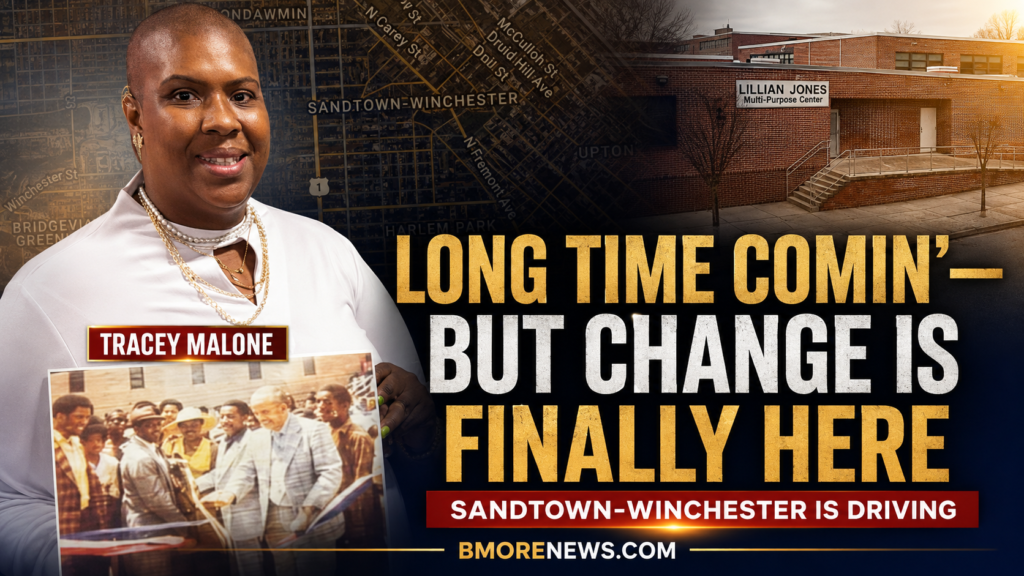
What is happening today is different.
In all my years in Sandtown-Winchester, I have never seen the community truly drive its own transformation.
We participated in programs. We attended meetings. We received services. We were consulted.
But we never controlled the process.
Today, for the first time, Sandtown-Winchester is driving.
This is new. This is uncharted territory. And that is the beauty of it.
Watching the Sandtown-Winchester Community Collective come together has been a true joy.
It is like watching a child grow up. For me, it is also like watching my own business evolve—seeing something develop its own identity, confidence, structure, and leadership.
The greatest joy has been watching and helping the next generation of leaders step up to the plate.
Bravo, Tracey Malone
Under the phenomenal leadership of Tracey Malone, I have witnessed more genuine self-empowerment in Sandtown-Winchester over the past three years than I did over the previous three decades.
Tracey deserves to be commended for her extraordinary and selfless service.
Community organizing is hard, hard work.
There are disagreements, competing personalities, disappointments, and meetings where progress feels painfully slow. It requires consistency. It requires continuing to show up, continuing to listen and continuing to bring people back to the table—even when you are tired.
After Freddie Gray’s death, I personally called approximately 30 community meetings.
Since Tracey came on board, she has convened, hosted, or led just as many—perhaps more. I have not counted them all, but what I have witnessed is unmistakable.
We have come together as a people.
Tracey has remained on the scene, doing the difficult and frequently thankless work of keeping residents engaged.
She cares more than most. That is the truth.
People like Tracey Malone are the salt of the earth.
She does not do this work alone. She is surrounded by a powerful village of residents, elders, emerging leaders and committed partners—including me—who believe in Sandtown-Winchester and support her leadership.
But every village needs someone willing to call the meeting, open the door, absorb the criticism, encourage the discouraged and return the next day ready to work again.
Tracey has been that person.
We are ever so proud of her.
Yes, Tracey Malone is the bomb.
Standing in the Gap
This new generation is also benefiting from the wisdom of leaders who have spent decades serving Baltimore.
Big ups to Marsha Bannerman, who remains right there, standing in the gap as she has done for years.
Marsha trained me. She helped teach me what community service, consistency, and commitment look like. Her work reaches back to Sandtown-Winchester’s original transformation era, and her presence provides an important bridge between yesterday’s leaders and the generation now stepping forward.
Elev8 Baltimore has also played an instrumental role in strengthening and supporting the Sandtown-Winchester Community Collective.
Under the leadership of CEO Alexandria Warrick Adams, Elev8 has provided critical support and backing while respecting the community’s leadership. Its work must not be minimized.
That is what a healthy partnership looks like.
An organization should not enter a neighborhood to take control, claim ownership or speak for its residents. A true partner brings knowledge, resources and support while allowing the community to retain its voice and drive its own agenda.
I must also thank my dear heart, Diane Bell-McKoy, for teaching me how to become the best steward I can be in my community.
Her wisdom has helped me understand that leadership is not about owning the work. It is about preparing others, sharing responsibility, and leaving the community stronger than you found it.
We Stand on Their Shoulders
We must also honor the countless soldiers who fought to build a better Sandtown but did not live to see this moment.
We send a special shout-out to heaven to Mr. Walter Thomas, Margaret Ruffin, Tina Thompson, Dr. Doug Stanton, Jerry Cross, Bill Hobbs, Brother Kenny, Ms. Alice, “Doc” Glover, Junior Grace, Allan Tibbels, Edward Hooks, Norman Yancey, Brother Ron and Father Damien Nalepa.
They attended meetings, challenged systems, created institutions, served their neighbors and carried Sandtown through difficult times.
They were not waiting for someone to rescue the community.
They were already doing the work.
We stand on their shoulders.
Today’s progress does not erase the past. It honors those who planted seeds they did not live to see fully bloom.
I believe our ancestors would be proud.
Government Must Support—Not Supplant—the Community
This is not necessarily an occasion to point fingers at individual elected officials.
You cannot simply say Councilman James Torrence did or did not do this, or State Senator Antonio Hayes did or did not do that. The same with the Mayor and the Governor.
These young men are on the job.
They deserve credit for listening, responding, and helping move public resources toward Sandtown-Winchester.
But elected officials can respond most effectively when an organized community clearly identifies its priorities, consistently shows up and demands action.
Bravo to the Baltimore City and State of Maryland officials who understand that investing in Sandtown-Winchester is neither charity nor robbery.
It is replenishment—a long-overdue return of public resources to a community that has contributed much, endured much, and gone without for far too long.
The new Lillian Jones Community Recreation Center will be built with public resources, but its foundation is being laid by residents who organized, persisted, and refused to surrender their voices.
This is not another transformation being done to Sandtown-Winchester.
It is not merely being done for Sandtown-Winchester.
It is being led by Sandtown-Winchester.
That has never happened before.
After decades of outsiders driving the car, the community finally has its own hands on the wheel.
Long time comin’—but change is finally here.
Attend the Lillian Jones Community Meeting
Date: Thursday, August 27, 2026
Time: 6 to 8 p.m.
Location: Parkview Recreation Center
Address: 2235 N. Fulton Avenue, Baltimore, MD 21217
Virtual option:
Join Zoom Meeting
https://us06web.zoom.us/j/9434417006?pwd=SWRNRk04bEZtUXJ2d2xNUnBRd3hlZz09&omn=87551752553
Meeting chat link
https://us06web.zoom.us/launch/jc/87551752553
Meeting ID: 943 441 7006
Passcode: 658523
RSVP: Email tony.savage@baltimorecity.gov and indicate whether you will attend in person or virtually. Residents are strongly encouraged to attend, review the plans, ask questions, and provide feedback. Sandtown-Winchester is driving now.