

(BALTIMORE – July 11, 2026) – Some opportunities become jobs. Others become traditions.
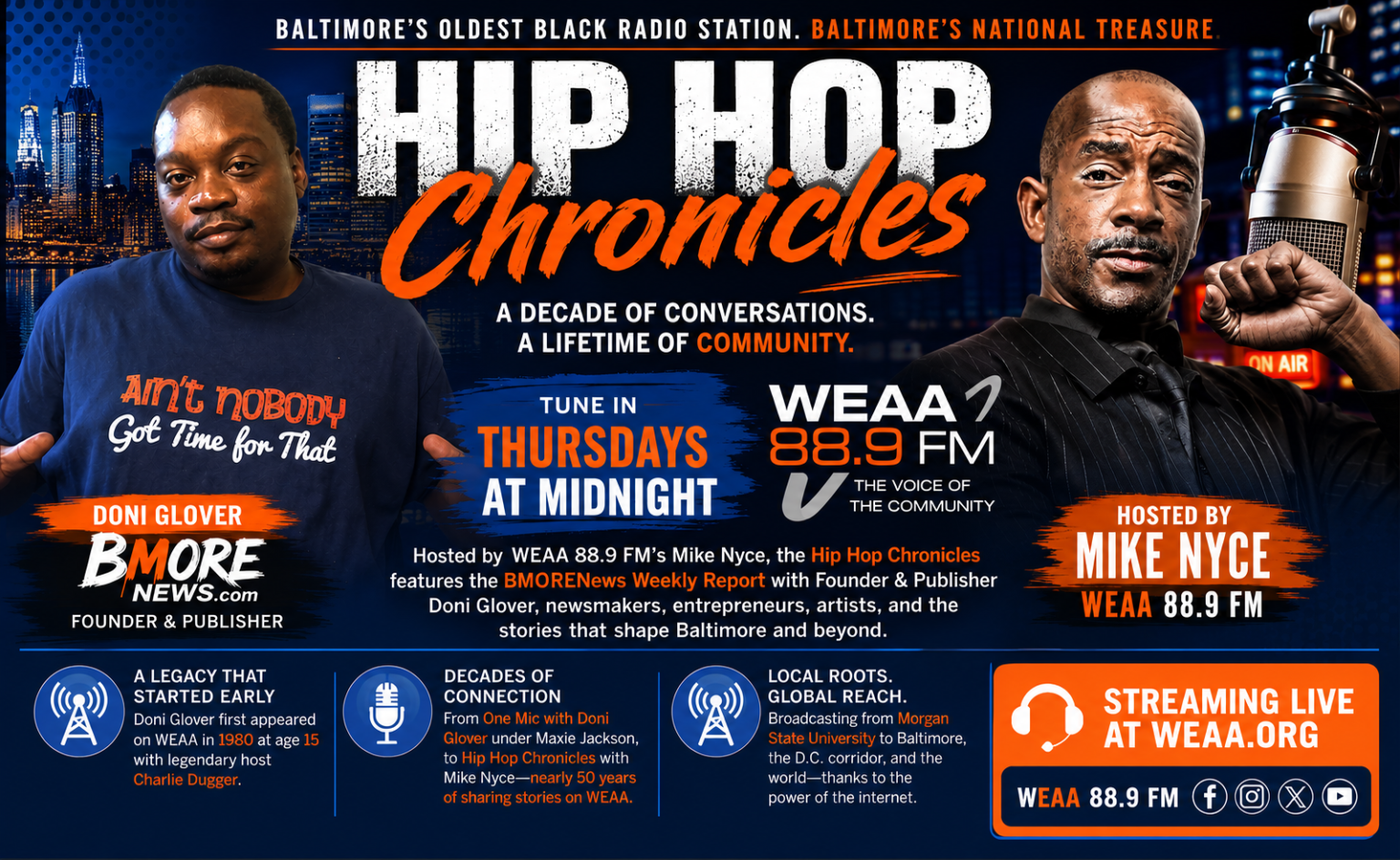
For the past decade, Hip Hop Chronicles on WEAA 88.9 FM, hosted by Mike Nyce, has become one of those traditions for me.
What began through a simple introduction by Frank Johnson evolved into a lasting partnership that has allowed me to bring the stories of BMORENews.com to one of Baltimore’s most respected airwaves every Thursday at midnight.
I remain grateful to Mike Nyce for opening that door.
Each week, our segment has featured newsmakers, entrepreneurs, elected officials, educators, artists, activists, and everyday Baltimoreans whose stories deserve to be heard. While many know me from BMORENews.com, this weekly appearance has also served as a continuation of a broadcasting career that included 21 years hosting my own radio program on Radio One’s WOLB 1010 AM.
In many ways, Hip Hop Chronicles became an extension of that legacy.
A Relationship with WEAA That Spans Nearly Five Decades
My relationship with WEAA actually began long before this weekly segment.
I first appeared on WEAA in 1980, when I was just 15 years old, as a guest of the legendary Charlie Dugger.
Those were remarkable years in the station’s history.
I still remember hearing and learning from people like Mary Carter Smith, Dr. Jesse McDade-Bey, Dr. Gossie Hudson, Dr. John Chizzell, Dr. Tyrone Powers, and so many others whose voices helped define Black radio in Baltimore.
Years later, under the leadership of General Manager Maxie Jackson, I had the privilege of hosting my own WEAA program, One Mic with Doni Glover.
Looking back, it’s remarkable to realize that my association with WEAA stretches from age 15 to 61—nearly half a century of intermittent appearances, interviews, conversations, and community engagement.
Growing Up on WEAA
My connection to WEAA isn’t simply professional.
It’s personal.
I grew up listening to WEAA.
Every Sunday, my mother faithfully tuned in to the station’s gospel programming.
Throughout the week, my father listened to its outstanding jazz lineup. Jazz filled our home, and WEAA became part of the soundtrack of my childhood.
My parents didn’t just listen.
They supported the station financially because they believed in its mission.
That appreciation has only grown stronger over the years.
One person who has deepened my understanding of WEAA’s history is Congressman Kweisi Mfume, a mentor and big brother whose own connection to the station has provided invaluable perspective on what WEAA has meant—not only to Morgan State University, but to Baltimore and Black America.
More Than a Radio Station
WEAA has always been far more than an FM signal.
Its reach extends throughout the Baltimore-Washington corridor, and today, thanks to internet streaming, its programming reaches listeners around the world.
More importantly, WEAA has served as a training ground, a cultural institution, a trusted news source, and a home for voices that might otherwise never have been heard.
It has educated.
It has entertained.
It has informed.
It has inspired.
It has preserved Baltimore’s rich Black cultural legacy for generations.
I’ve also had the privilege of knowing and learning from many of WEAA’s outstanding personalities over the years, including Gary Ellerbe, one of Baltimore’s foremost historians and an extraordinary authority on African American classical music—better known to most as jazz.
These broadcasters did more than host radio programs.
They documented our history.
Looking Ahead
As I reflect on the past ten years of appearing every Thursday night on Hip Hop Chronicles, I do so with gratitude.
Thank you to Mike Nyce for your friendship, professionalism, and commitment to giving Baltimore a platform.
Thank you to Frank Johnson for making the introduction that started this journey.
And thank you to the countless pioneers who built WEAA into one of Baltimore’s most respected institutions.
For generations, WEAA has amplified Black voices, celebrated Black excellence, and strengthened our community.
Here’s to many more years of telling Baltimore’s stories.
Because institutions like WEAA don’t simply broadcast history.
They help make it.
#NationalTreasure