




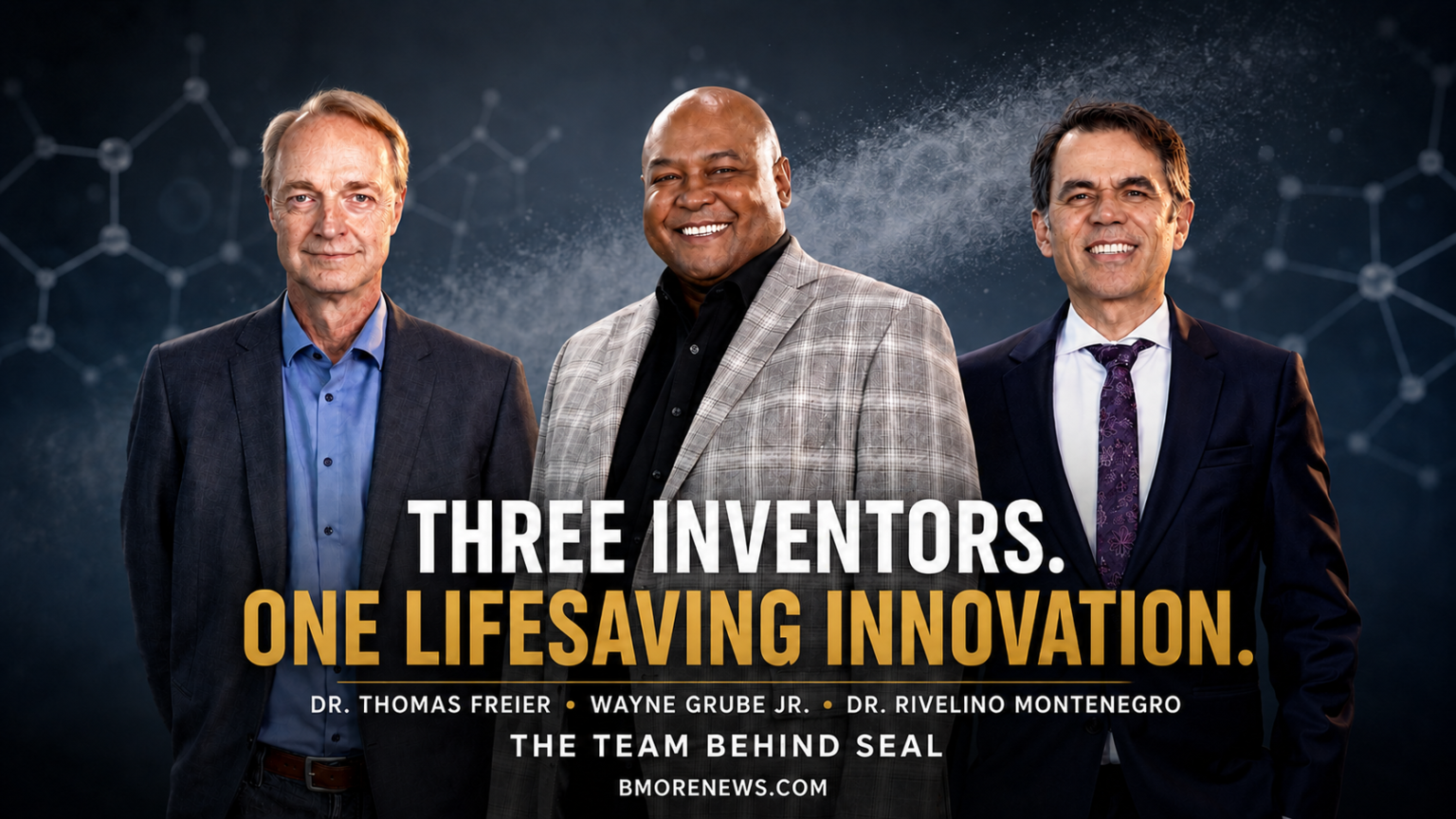
Wayne Grube Jr. built upon six decades of family manufacturing experience to help create SEAL Hemostatic Wound Spray as TEDCO invests in Baltimore innovation
(BALTIMORE – August 4, 2026) — Behind BC3 Technologies’ projected 500% revenue growth, its FDA-cleared wound spray and a new $200,000 investment from TEDCO is a Baltimore family manufacturing story that began more than six decades ago.
Wayne Grube Jr., the Black CEO and co-founder of Baltimore-based BC3 Technologies, did not enter the medical technology industry from nowhere.
His father, Wayne Grube Sr., began working in the filling and packaging industry in 1964. After approximately 36 years in the business, the elder Grube founded Aerosol and Liquid Packaging—also known as A&L Packaging—in Baltimore in 2000.
According to the company’s official history, Grube Sr. established the business partly because he wanted to leave a legacy for his children.
That legacy now includes SEAL Hemostatic Wound Spray, an FDA-cleared aerosolized product designed to help control severe external bleeding before professional medical assistance arrives.
Every can of SEAL is manufactured by the family’s Baltimore packaging company, according to reporting by the Baltimore Business Journal.
What began with Wayne Grube Sr. entering the packaging industry in 1964 has evolved into a second-generation manufacturing and medical technology story more than 60 years in the making.
Continuing the Family Business
According to a public account from family member and journalist Bonnie Newman Davis, Wayne Grube Sr. died suddenly in 2009. His sons, Wayne Jr. and Lee Jay Jr., then helped continue the family business.
Davis, who identified Wayne Sr. as her uncle and Jean Chavis Grube as her aunt, wrote that Jean maintained control of the company while her sons kept its operations moving.
Wayne Jr. became vice president of Aerosol and Liquid Packaging, while Lee worked alongside him. Lee later became chief operating officer of BC3 Technologies.
A&L is a full-service contract manufacturer capable of taking products through multiple stages of development and production. The company says its services include product development, material sourcing, chemical compounding, quality control, aerosol and liquid filling, bottling and packaging.
It handles both small and large production runs and describes itself as an FDA-registered member of the National Association of Manufacturers.
Wayne Jr.’s work inside the family business exposed him to aerosol manufacturing, chemistry, federal regulation, product development, consumer distribution and business-to-business retail.
He has also publicly described experience developing personal-care products, cosmetics, laundry detergents, dietary supplements, hair sprays and dry shampoos.
But after years of manufacturing products for other businesses, the brothers wanted to create something of their own.
“My journey into founding BC3 Technologies was a natural progression from my background and experience at Aerosol and Liquid Packaging,” Grube said in a 2025 CityBiz interview. “Working alongside my brother Lee, BC3’s COO, at our family business, I realized we wanted to make something of our own that would be impactful.”
That ambition became BC3 Technologies.
Three Inventors, Three Areas of Expertise
The creation of SEAL required more than aerosol-manufacturing experience.
Grube partnered with Dr. Thomas Freier and Dr. Rivelino Montenegro, scientists with specialized experience in chemistry, biomaterials, drug delivery, medical devices, and chitosan-based technology.
Chitosan is a biologically derived material capable of assisting the body’s clotting response. Combining that material with an aerosol delivery system created the foundation for a product that could be applied rapidly to a severely bleeding wound.
The patent record identifies Wayne Grube Jr., Thomas Freier and Rivelino Montenegro as the three inventors of the hemostatic material and spray technology.
Freier now leads research and development at BC3, while Montenegro heads regulatory affairs. Grube brought the aerosol-manufacturing, commercialization, and regulatory experience developed through his family’s company.
That distinction is important.
SEAL was not invented by Grube alone, nor did it emerge solely from a laboratory. It resulted from the combination of scientific knowledge and the practical manufacturing experience necessary to transform that science into a marketable product.
The aerosol format was not a gimmick. It was the bridge between the family business and an unmet medical need.
The U.S. Patent and Trademark Office issued Patent No. 12,263,185 on April 1, 2025. The patent covers the hemostatic material, aerosolized spray formulation, and method for applying it to a bleeding wound.
A Product Designed to Buy Time
Severe bleeding can become fatal within minutes. In many trauma situations, the injured person must survive the period between the initial wound and the arrival of professional medical care.
BC3 developed SEAL as a “Shake-Spray-Pressure” system designed to help control severe external bleeding rapidly.
“BC3 Technologies was founded on the belief that lifesaving innovation is meant to be accessible to everyone,” Grube said. “The growth we are experiencing reflects the increasing recognition that preparedness matters.”
SEAL received FDA 510(k) clearance in 2023. BC3 describes it as the first and only FDA-cleared aerosolized chitosan wound spray for controlling severe external bleeding.
The product also received the 2023 EMS World Innovation Award.
According to BC3, SEAL is now sold and used in all 50 states and by hundreds of emergency medical service agencies, fire departments, law enforcement organizations and first-responder teams.
BC3 says its product has also been used by military personnel and international organizations. The company has reported exports to Israel, South Africa, Ukraine, Somalia, Poland and Mozambique.
The company’s international work earned Grube recognition as a 2024 Maryland Small Business Exporter.
SEAL is also eligible for purchase through Health Savings Accounts and Flexible Spending Accounts, according to BC3.
A Long Road to Commercialization
BC3’s recent success did not happen overnight.
The Baltimore Business Journal first reported on the company in May 2018, when Grube was seeking to raise $500,000 to bring the bleeding-control spray to market. At that point, he said he had already been working on the concept for approximately four years.
That places the product’s early development around 2014—four years before BC3 Technologies was formally founded in Baltimore in 2018.
Five years later, the Business Journal reported that BC3 had raised $1.7 million in venture capital as it prepared to launch the product following FDA clearance.
Grube has described the difficulty of raising research-and-development funding, navigating the FDA process, establishing credibility in the medical-device industry and persuading potential customers to trust an unfamiliar technology.
BC3 worked with medical, emergency-response and military professionals to demonstrate the product and build support for its use.
The company’s progress included securing Maryland approval for SEAL to be used by emergency medical clinicians, establishing distribution through First Aid Only and reaching international markets.
In July 2026, the Baltimore Business Journal reported another significant milestone: videos featuring SEAL had gained substantial attention on TikTok, helping drive consumer demand.
Grube told the publication that BC3 expected to generate more than $3.5 million in 2026 sales. The company had also secured an agreement to place SEAL in more than 100 military-base stores.
Those projections are consistent with BC3’s announcement that it is on track for more than 500% revenue growth in 2026.
The company reports that revenue during the first half of 2026 was 10 times greater than during the same period in 2025. BC3 also says it surpassed $1 million in direct-to-consumer sales during the first six months of this year.
These financial figures are company-reported and have not been independently audited or verified by BMORENews.com.
TEDCO Invests $200,000
BC3’s growth has now attracted a $200,000 investment from the Maryland Technology Development Corporation, better known as TEDCO.
The investment came through TEDCO’s Pre-Seed Builder Fund, which operates under its Social Impact Funds. The fund was established to expand access to capital and support for technology and life-sciences entrepreneurs who have historically been overlooked by traditional investment networks.
“With TEDCO’s investment, we will continue our growth, enhance research and product development, and advance our mission of making lifesaving technology more accessible,” Grube said.
In addition to capital, companies selected for the Builder Fund can receive mentorship, operational guidance and access to TEDCO’s statewide network of advisers and investors.
BC3 currently employs 15 people, up from five employees in 2023, and says it expects to create more than 20 additional Maryland-based jobs over the next several years.
The company reports that it has invested several million dollars in its Maryland operations. Its products are manufactured and distributed in Maryland.
“Maryland has been central to BC3’s success from the beginning,” Grube said. “We’re proud to continue growing our company, creating jobs and developing lifesaving technology right here in Maryland.”
BC3 Is Part of a Broader TEDCO Story
While BC3 provides the immediate headline, TEDCO’s economic reach extends across Maryland.
An independent study conducted by the University of Baltimore’s Jacob France Institute found that companies and research supported through TEDCO’s major programs generated an estimated $2.7 billion in Maryland economic activity in 2023.
That activity supported approximately 12,082 jobs paying $1.1 billion in labor income and generated an estimated $140.3 million in state and local tax revenue.
The study identified 442 Maryland technology companies that had received investment or other support through TEDCO’s primary funding programs.
It also estimated that TEDCO-supported economic activity produced approximately $80.1 million in state government revenue—more than the organization’s $50.5 million fiscal year 2023 state appropriation.
Those figures represent statewide estimates, not Baltimore-only results. However, numerous Baltimore companies have received TEDCO investments and support.
Recent examples include:
- CurieDx, a Baltimore health-technology company developing an artificial intelligence-powered medical screening application, received a $200,000 Social Impact Funds investment.
- ICaPath, a Baltimore biotechnology company developing nanoparticle-based cancer immunotherapy, received a $500,000 Venture Funds investment.
- TechRow, a Baltimore artificial intelligence-enabled media platform, received a combined $500,000 through TEDCO’s Inclusion Fund and Venture Funds.
- EcoMap Technologies, a Baltimore company developing technology for mapping and measuring entrepreneurial ecosystems, received more than $100,000 through TEDCO’s Seed Funds.
- Irazú Oncology, located at the University of Maryland BioPark in Baltimore, received $250,000 to advance cancer immunotherapy technology.
These investments illustrate TEDCO’s role in helping move Maryland ideas from laboratories, universities, startups and family businesses into commercial markets.
Who Benefits From Maryland’s Innovation Economy?
TEDCO’s record presents an important public-policy question for Baltimore: Who receives the capital necessary to transform an idea into a company?
A promising concept is rarely enough.
Technology entrepreneurs also need attorneys, regulatory advisers, laboratories, manufacturing partners, experienced executives and investors willing to finance years of research and product development.
Founders without established access to those networks begin the race several steps behind.
TEDCO’s Social Impact Funds attempt to address part of that disparity by directing investments and assistance toward entrepreneurs and communities frequently overlooked by conventional financing sources.
That mission does not place TEDCO beyond scrutiny.
As a quasi-public organization investing public resources, TEDCO should be examined for transparency, geographic distribution, founder diversity, company survival, private capital raised and actual job creation.
Baltimore residents should be able to determine how much TEDCO funding reaches businesses within the city, where those businesses operate, and whether the resulting employment opportunities are accessible to city residents.
BC3 Technologies provides an immediate example of what is possible when technical expertise, manufacturing capacity and investment capital come together.
A Black Manufacturing Story Hidden in Plain Sight
The first impression of BC3 may be that of a modern medical technology startup supported by scientists, physicians, military advisers and state investors.
All of that is true.
But underneath the company is something more familiar and more deeply rooted: a father who spent decades learning a trade, started a business and intended to leave something for his children.
His sons continued that business. They learned its machinery, chemistry, regulations, customers and challenges. Then they used that inherited knowledge to build something new.
Wayne Grube Jr. did not merely place his name atop a medical technology company. He brought the manufacturing knowledge developed through his father’s life’s work into a partnership with scientists who possessed the complementary expertise necessary to address a deadly medical problem.
The result was an FDA-cleared product manufactured in Baltimore and sold nationally and internationally.
That makes BC3 Technologies more than another startup celebrating a round of funding.
It is a Black entrepreneurship story. It is a Baltimore manufacturing story. It is a medical technology story. It is a story about the transfer of knowledge from one generation to the next.
And it is evidence that Black innovation is not limited to starting new businesses. Sometimes it means taking what the previous generation built and carrying it into an entirely new industry.