



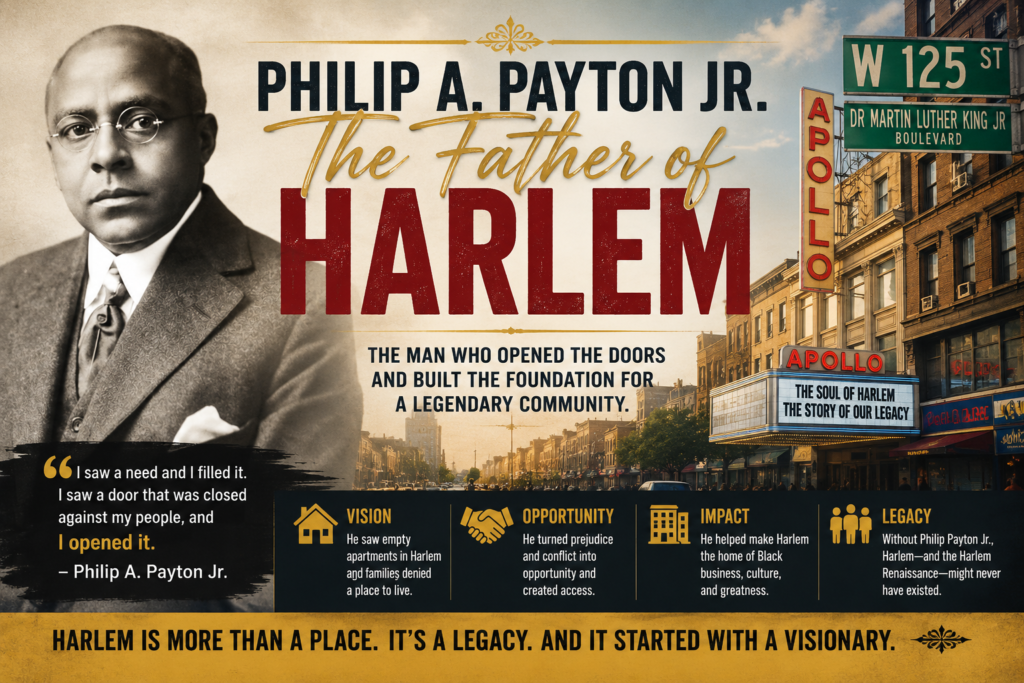
(HARLEM, NY – July 8, 2026) – Our history is significant.
There are countless stories of melanated people in America that remain untold—from inventions and scientific breakthroughs to medicine, music, art, education, business, and real estate. Time and again, Black Americans have shattered glass ceilings erected by systems rooted in white supremacy, creating institutions and opportunities that transformed not only our communities but the nation itself.
When it comes to real estate, however, there is one name that deserves far greater recognition.
You cannot begin to tell the story of Harlem—what it has meant to Black America, what it has meant to the world, and what it has produced—without first telling the story of the man known as the Father of Harlem.
Most people know the giants of Harlem’s cultural legacy.
They know Langston Hughes, the poet laureate of the Harlem Renaissance. They know Zora Neale Hurston, whose writing preserved the richness of Black Southern life. They know W. E. B. Du Bois, whose scholarship and activism helped shape modern America. They know Marcus Garvey, whose vision of Black pride and economic independence inspired millions around the globe. They know Duke Ellington, whose music forever changed jazz. They know James Baldwin, Billie Holiday, Kareem Abdul-Jabbar, Sugar Ray Robinson, Sammy Davis Jr., and Tupac Shakur.
Their names are woven into the fabric of American history.
But how many people know the name of the man who helped make modern Harlem possible?
How many know the story of Philip A. Payton Jr.?


Even more importantly, how many understand the conditions that created him?
At the turn of the twentieth century, Harlem was not yet the cultural capital of Black America. African Americans were largely confined to overcrowded neighborhoods such as the Tenderloin and San Juan Hill. Although new apartment buildings were rising in Harlem, many white landlords refused to rent to Black families. The result was a cruel contradiction: Black families desperately needed decent housing while perfectly good apartments sat vacant because of racial prejudice.
Philip Payton saw what others did not.
He recognized that discrimination had created not only injustice but also opportunity.
According to Payton’s own account, his first major opportunity came because two white landlords were feuding. Seeking revenge against his rival, one landlord turned a building over to Payton to lease and manage. Payton filled the apartments with Black tenants who had long been denied access to quality housing. The building prospered. Soon other landlords approached him to manage their properties as well.
It was an extraordinary lesson in entrepreneurship.
Where others saw conflict, Philip Payton saw possibility.
Where others saw race, he saw a market.
Where others saw empty buildings, he saw families looking for a place to call home.
In 1904, Payton organized the Afro-American Realty Company with the stated mission of combating housing discrimination against African Americans. His efforts would soon ignite what historians have called Harlem’s “Real Estate Race War.”
As more Black families moved into Harlem, some white property owners feared their neighborhoods were changing. White-owned real estate companies attempted to prevent Black occupancy and protect segregated housing patterns. Payton responded by acquiring, leasing, and managing additional properties for Black tenants. What followed became a public struggle over who would determine Harlem’s future: racial exclusion or economic reality.
Economic reality won.
By opening Harlem’s doors to Black families, Payton helped create the population density that made everything else possible.
The churches.
The newspapers.
The businesses.
The civic organizations.
The music.
The poetry.
The politics.
The restaurants.
The intellectual life.
The entrepreneurs.
The Harlem Renaissance did not emerge in a vacuum. It grew from a community. Philip Payton helped build that community.
History, however, is rarely simple.
Some modern scholars, including historian Kevin McGruder, have argued that Payton’s legacy is more complicated than many realize. While crediting him with helping establish modern Black Harlem, McGruder also notes that Payton’s business practices reinforced residential segregation and that some Black tenants later complained about paying higher rents than previous white occupants had paid. Those realities deserve honest discussion, reminding us that pioneers are often both products of their time and agents of profound change.
Yet none of that diminishes Payton’s place in American history.
Without Philip Payton, Harlem almost certainly develops differently.
Without Philip Payton, the Harlem Renaissance may never emerge as we know it.
Without Philip Payton, Harlem’s reputation as the cultural and intellectual capital of Black America may never have been realized.
As Harlem prepares to celebrate Black Wall Street Harlem on Saturday, July 25, perhaps there is no better moment to remember the man whose vision helped shape one of the most influential Black communities on Earth.
Millions of people have walked the streets of Harlem.
Millions have visited the Apollo.
Millions know the names of Harlem’s greatest artists, athletes, activists, and entertainers.
It is time they also learned the name of the man who helped make Harlem possible.
His name was Philip A. Payton Jr.
He was, and remains, the Father of Harlem.