




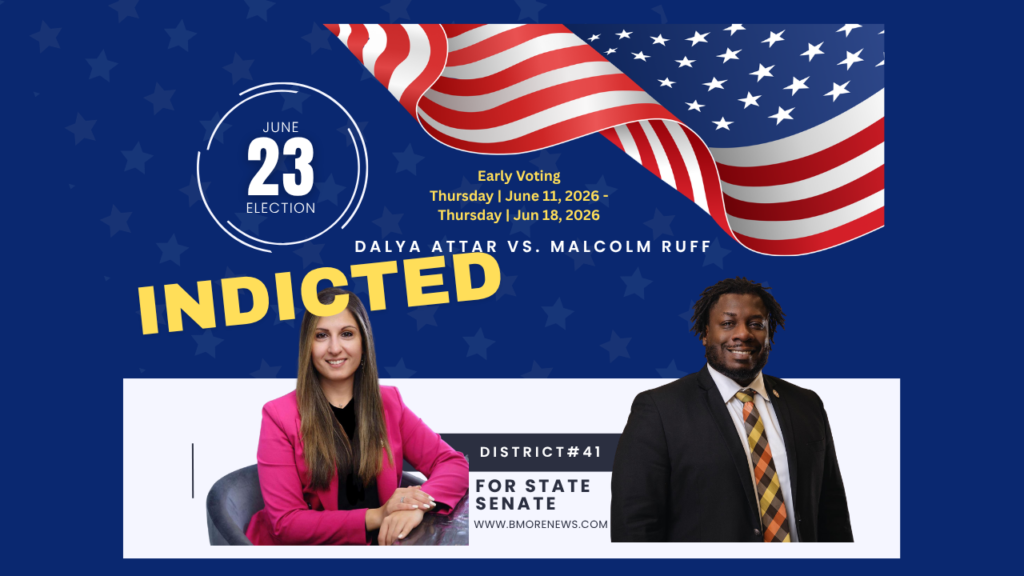
(BALTIMORE – May 22, 2026) – Nat Oaks. Larry Young. Sheila Dixon. Catherine Pugh. Marilyn Mosby.
In Baltimore politics, we have seen this movie before.
A Black elected official gets indicted, and suddenly the same courthouse footage loops endlessly on television — walking beside a lawyer, head down, cameras flashing, public opinion already forming long before a verdict is ever reached.
As a journalist, I know the drill all too well.
Particularly in Baltimore, the rise and fall of Black politicians has often been treated not simply as news coverage, but as spectacle. The imagery becomes the story. The accusation becomes the conviction in the minds of many viewers before a case is ever tried.
And yet, watching the public conversation surrounding Dalya Attar, I cannot help but notice a different tone.
Not no coverage.
Not no criticism.
But different.
Less urgency. Less outrage. Less nonstop repetition. Less political panic.
That inconsistency deserves examination.
Because whether one supports Attar or not, whether she is ultimately found guilty or innocent, indictment is serious business. Federal indictments are not parking tickets. They carry enormous legal, emotional, political, and public consequences.
And the allegations themselves are serious.
Do we really want a state senator accused of using intimidation and political pressure tactics to secure support?
At times, the allegations sound less like public service and more like something straight out of The Wire — and yes, that show spent plenty of time exploring political corruption in Baltimore.
Coming from Baltimore City, I cannot imagine someone attempting to strong-arm me into political loyalty. And if the allegations are true, involving law enforcement in personal political disputes only deepens the concern.
Then there are the allegations involving surveillance inside a private residence — accusations that many ordinary voters would likely find deeply disturbing regardless of political affiliation.
These are not small matters.
The question is not guilt.
The question is accountability and consistency.
Over the years, Baltimore has watched Black politicians publicly dragged through the mud from the moment charges were announced. Careers collapsed before trials concluded. Reputations were shattered in real time. Some were politically isolated almost immediately.
So naturally, some voters are asking: Why does this situation feel different?
That question is not rooted only in the Black community. The 41st Legislative District is politically and demographically diverse. Not every Jewish voter supports Attar. Not every white voter supports an indicted senator, either. Many residents — regardless of race or religion — simply want transparency, ethical leadership, and confidence that their elected officials can fully serve the public while managing serious legal challenges.
That concern is legitimate.
And the record raises its own questions. In the most recent legislative session, Attar passed two bills — one extending a liquor license at Pimlico during redevelopment, and another involving stop-sign camera monitoring — while reportedly missing a substantial number of Senate floor votes. That record raises legitimate questions about capacity and focus, independent of any legal proceedings.
Delegate Malcolm Ruff appears to understand that reality. By all accounts, he has continued doing what campaigns are supposed to do: knocking on doors, meeting voters, shaking hands, and making his case directly to constituents.
And frankly, that may matter more than anything else.
Politics is still about contact.
It is still about trust.
It is still about whether voters believe a candidate sees them, hears them, and understands their frustrations.
According to Ruff, his campaign has knocked on more than 12,000 doors throughout the district. That matters because while media narratives shape perception, elections are often decided in living rooms, on porches, and at kitchen tables.
Ruff’s broader argument appears to be centered on effectiveness as much as ethics. He points to concerns about missed Senate votes and questions whether an indicted lawmaker can fully focus on legislative responsibilities while simultaneously fighting federal charges.
Those are fair political questions.
Not hateful questions.
Not extremist questions.
Political questions.
And voters deserve the opportunity to wrestle with them honestly — without selective outrage, without media theater, and without pretending indictments are insignificant depending on who is involved.
If Baltimore is going to have standards, then those standards should apply evenly.
Not sometimes.
Not selectively.
Not only when convenient.
Doni Glover is the founder and publisher of BMORENews.com, now in its 24th year of covering Black Baltimore, and the founder of the Joe Manns Black Wall Street Awards, now in its 15th year. He is also the host of the Emmy-nominated Doni Glover podcast and The Doni Glover Show on WMAR-TV 2.