


BMORENews Investigates: The AI Infrastructure Files
(BALTIMORE – July 14, 2026) – Before BMORENews goes any further into the data center conversation, we need to slow down and answer a basic question:
What exactly is a data center?
That might sound obvious.
It isn’t.
In the weeks since publishing Part 1 of this investigation, one thing has become increasingly clear: much of the confusion surrounding data centers—the conflicting statistics, competing narratives, and even many of the political debates unfolding in Annapolis—comes down to people using the same words to describe very different things.
Before we ask who pays for data centers, how much electricity they consume, how much water they require, or what they mean for Maryland’s future, we need a common understanding of what we’re actually talking about.
Consider this article the foundation for everything that follows.
Not Every “Data Center” Is the Same Building
When most people hear the phrase “data center,” they imagine a giant warehouse filled with endless rows of computers somewhere beyond the suburbs.
Sometimes that’s exactly what it is.
Often, it isn’t.
The term “data center” actually describes several very different types of facilities.
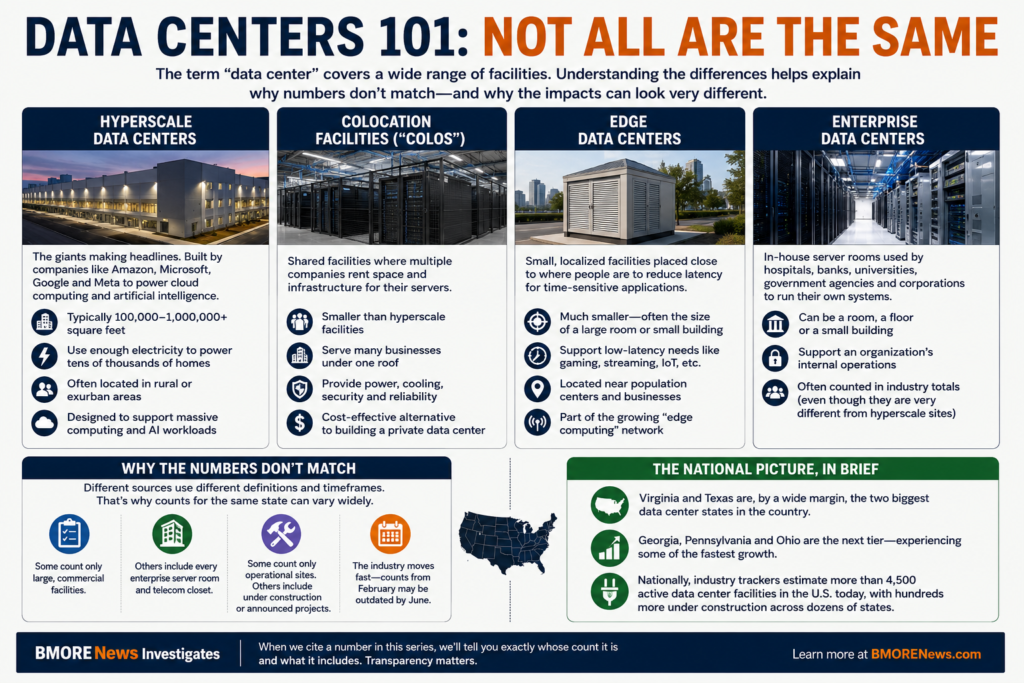
Hyperscale data centers are the giants making today’s headlines. Typically encompassing hundreds of thousands of square feet, these facilities are built by companies such as Amazon, Microsoft, Google, and Meta to power cloud computing and, increasingly, artificial intelligence. When news reports describe facilities consuming enough electricity to power tens of thousands of homes, these are usually the buildings being discussed.
Colocation facilities, commonly known as “colos,” operate differently. Rather than serving a single company, they lease space to multiple businesses, allowing organizations to house their servers in a shared facility instead of building their own.
Edge data centers are much smaller facilities strategically located closer to population centers. Their purpose is to reduce delays—or latency—for applications such as video streaming, online gaming, autonomous vehicles, and other services requiring rapid response times.
Enterprise data centers are perhaps the most overlooked. Hospitals, banks, universities, government agencies, and large corporations have maintained in-house server rooms for decades. They may occupy a floor of an office building or a secure room in a basement. Many industry databases count these facilities alongside hyperscale campuses, even though the two have little in common beyond housing computer equipment.
Understanding those distinctions is essential because it explains one of the biggest frustrations readers encounter when researching this topic.
Why the Numbers Never Match
In Part 1, BMORENews noted that Virginia has been reported as having anywhere from roughly 300 operational data centers to well over 900, depending on the source.
That is not a typo.
Nor does it necessarily mean one organization is right and another is wrong.
The differences usually come down to methodology.
Some organizations count only large, verified commercial facilities.
Others include enterprise server rooms, telecommunications facilities, and colocation centers.
Some count only facilities that are currently operating.
Others include projects under construction, approved developments, or even announced projects that have yet to break ground.
And because the industry is expanding so rapidly, a count published in February may differ substantially from one published only a few months later.
Definitions matter.
That is why readers will occasionally encounter different statistics throughout this series.
Whenever BMORENews cites a number, we will identify its source and, whenever possible, explain what that number actually measures.
Our goal is not to find one magical “correct” figure.
Our goal is to help readers understand what each dataset represents—and why transparency about methodology matters.
The National Picture
Despite differences among industry trackers, several broad trends are remarkably consistent.
Virginia and Texas remain the nation’s dominant data center states, leading the country in both operating facilities and new construction.
Georgia, Pennsylvania, and Ohio represent the next wave of growth, with substantial expansion planned over the next several years.
Nationally, industry estimates place the number of active data center facilities at well over 4,500, with hundreds of additional facilities under construction across dozens of states.
Although organizations may disagree about the precise totals, they overwhelmingly agree on one point:
America’s AI infrastructure is expanding at an unprecedented pace.
Why This Matters to Maryland
Maryland finds itself in a unique position.
To the south sits Northern Virginia, home to the world’s largest concentration of data centers.
To the north and west, Pennsylvania and Ohio are aggressively competing for new investment.
Maryland must now determine what role it wants to play in this rapidly evolving industry.
Should it compete more aggressively?
Should it proceed cautiously?
Should it emphasize environmental protections?
Should it prioritize economic development?
Or should it attempt to strike a balance among all of those goals?
Those questions cannot be answered until policymakers and the public share a common understanding of what data centers are—and what they are not.
Setting the Table for What’s Next
Understanding what a data center is is only the beginning.
The larger questions remain unanswered.
Who pays for the electricity required to power artificial intelligence?
Where will that electricity come from?
How much water will these facilities consume?
How should Maryland compete with neighboring states while protecting its communities, natural resources, and ratepayers?
And what role should Maryland’s own universities play in helping policymakers answer those questions?
In the next installment, BMORENews will examine why Maryland finds itself geographically and politically squeezed between Virginia, Pennsylvania, and Ohio as those states compete to attract billions of dollars in AI infrastructure investment.
Then we’ll turn our attention home.
One of Maryland’s greatest competitive advantages may not be the number of data centers it builds, but the depth of expertise it already possesses. Johns Hopkins University, Morgan State University, and the University of Maryland are each studying different dimensions of AI infrastructure—from grid reliability and engineering to environmental justice and equitable artificial intelligence. We’ll examine what their research can teach policymakers, business leaders, and the public as Maryland charts its course.
This is a complicated story.
BMORENews intends to tell it one honest piece at a time.
If you have information, questions, or concerns about data centers in your neighborhood, contact BMORENews at doni@bmorenews.com. This investigation is ongoing, and community experience matters.
Sources for This Report
- Pew Research Center
- Data Center Map
- Maryland General Assembly
- Maryland Office of People’s Counsel
- Maryland Tech Council
- Lawrence Berkeley National Laboratory
- U.S. Department of Energy
- World Population Review (comparative facility counts)
- Industry and academic sources cited throughout this investigative series
Doni Glover is the founder and publisher of BMORENews.com, now in its 24th year of covering Black Baltimore, and the founder of the Joe Manns Black Wall Street Awards, now in its 15th year. He is also the host of the Emmy-nominated Doni Glover podcast and The Doni Glover Show on WMAR-TV 2.
__________________________________________
Related Article