

In a recent conversation, I made a statement that raised eyebrows:
Baltimore has some of the most politically astute citizens in America.
Look no further than Legislative District 45.
More than a dozen Democratic candidates have filed for Central Committee alone. That level of engagement is not accidental. It reflects a community that understands power — not just at the top of the ballot, but inside the party structure itself.
That is political literacy.
That is civic awareness.
That is Baltimore.
Meanwhile, In Baltimore County…
Contrast that with Baltimore County.
There are competitive races in Councilmanic Districts 2, 3, and 4. There’s movement in Legislative District 10. There is potential for historic Black representation on the County Council.
But where is the density of engagement?
Given how much Black residents contribute to the County’s tax base, workforce, business ecosystem, and culture, one would expect deeper political competition and broader civic activation.
Baltimore County is growing politically.
Baltimore City has been politically sharp for generations.
Representation Is Not A Social Media Post
Here’s the uncomfortable truth:
Too many elected officials believe posting online equals presence.
It does not.
Come to our community meetings.
Walk our blocks.
Visit our small businesses.
Attend the neighborhood associations that meet whether cameras are present or not.
If you represent underserved communities, you must physically show up in those communities.
The old myth says, “Those neighborhoods don’t vote.”
That myth is wrong.
Senator Antonio Hayes and Senator Cory McCray have repeatedly demonstrated that consistent presence in working-class communities produces turnout, loyalty, and trust. They show up.
Representation requires more than a press release.
It requires proximity.
We Do Not Need Placeholders
Baltimore voters are not naïve.
We have stood in line at 7 a.m. to vote in historic elections. We have organized. We have protested. We have campaigned. We understand what political activism looks like.
We do not need placeholders padding résumés.
We do not need career ladder climbers who view our neighborhoods as stepping stones.
We need worker bees.
We need legislators who bring resources back home.
We need people who fight for capital investment, school funding, housing dollars, infrastructure, and business development — not just committee titles.
If you cannot visit our community, do not expect our votes.
And understand this clearly: Baltimore talks. If you do not show up, that reality will travel faster than any campaign mailer.
No To Nepotism Politics
We are not endorsing family legacies for the sake of legacy.
We are not supporting surnames.
We are supporting work.
Who are you related to does not matter.
What have you done?
What rooms have you entered on behalf of the people?
What legislation have you advanced?
What dollars have you secured?
Baltimore has seen political games before. We are not new to this.
History Matters — Whether You Like It Or Not
For those who dismiss history as irrelevant — especially Black political history — that is dangerous.
Baltimore’s political awareness did not appear overnight. It was built through struggle, organizing, sacrifice, and disciplined voting behavior.
People marched.
People risked livelihoods.
People endured violence.
Political power was not handed to us. It was earned.
If you seek to represent Black communities while dismissing Black political memory, you misunderstand the assignment entirely.
The Bottom Line
Baltimore City’s political sophistication is undeniable. Legislative District 45 proves that interest in governance runs deep.
Baltimore County has opportunity — particularly in districts where Black representation can expand — but civic intensity must match economic contribution.
And for every candidate, whether in the city or county:
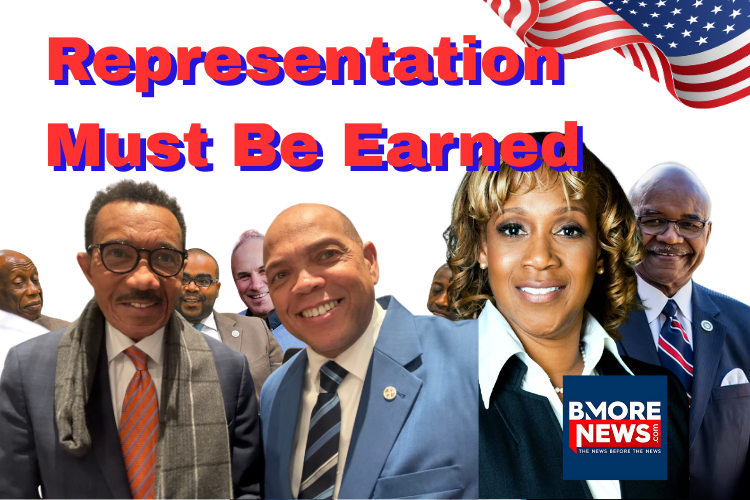
Representation is earned in community rooms, not just online feeds.
Show up.
Do the work.
Bring back the resources.
Anything less is not leadership.
It is theater.