

TUNE IN TO THE INDIGENOUS SERIES ON YOUTUBE
(BALTIMORE – March 15, 2026) — Sometimes history hides in plain sight. Sometimes it lives quietly inside the human body — waiting for science to catch up to what our ancestors already knew.
Two Black Americans — separated by time, circumstance, and geography — each reshaped humanity’s understanding of itself. Neither asked for the role. Neither was compensated for it. And for far too long, neither received the recognition they deserved.
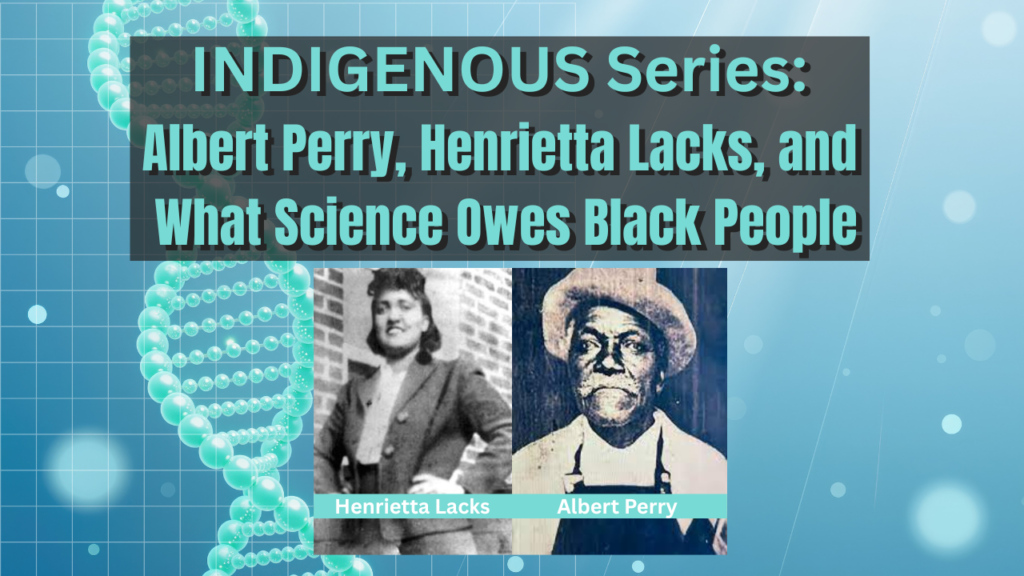
Their names were Albert Perry and Henrietta Lacks.
And their stories are not just about science. They are about who gets to own the truth of Black biological legacy — and who has profited from it without permission.
Albert Perry and the Oldest Known Bloodline
When scientists examined the Y-chromosome of Albert Perry’s male descendants, they uncovered something that rewrote the timeline of human history.
The genetic strand passed from father to son didn’t match any known lineage. It didn’t fit any existing category.
Further analysis revealed that Perry’s line carried Haplogroup A00, the oldest known paternal lineage ever identified — dating back more than 300,000 years.
His lineage diverged extremely early in human history, pushing the known timeline of paternal ancestry further into the past than scientists had previously believed.
Let that land.
A man born into the legacy of American slavery carried within him one of the oldest surviving genetic signatures of humankind.
Subsequent research found the same ancient lineage still present among the Mbo people of Cameroon, confirming that Perry’s DNA was not an anomaly. It was a living remnant of humanity’s earliest paternal heritage.
For the scientific community, this was a data point.
For us, it was confirmation.
The story of Black people does not begin with slavery. It reaches back to the very dawn of the human family.
Henrietta Lacks: The Woman Behind Modern Medicine
Four decades before Albert Perry’s DNA captured the world’s attention, another Black American unknowingly changed the future of medicine.
In 1951, a young woman named Henrietta Lacks walked into Johns Hopkins Hospital in Baltimore seeking treatment for cervical cancer.
She was 31 years old. A mother of five. A resident of Turner Station — a historically Black community just outside the city.
Without her knowledge. Without her consent. Without so much as a conversation with her family, doctors removed samples of her tumor cells.
Those cells turned out to be unlike anything science had seen before.
They became known as HeLa cells — the first human cells capable of reproducing indefinitely outside the body.
They didn’t die in a laboratory dish. They multiplied. They thrived.
And they went on to fuel breakthroughs including the polio vaccine, cancer treatments, genetic mapping, and even research that helped accelerate the development of COVID-19 vaccines.
Henrietta Lacks helped save millions of lives.
She died in the segregated ward of Johns Hopkins that same year.
She was buried in an unmarked grave.
Her family struggled for decades to afford the very healthcare her cells were quietly revolutionizing.
Meanwhile, pharmaceutical companies were building billion-dollar industries on her DNA.
Justice — Long Overdue
More than 70 years later, the Lacks family began to fight back.
Represented by civil rights attorney Ben Crump, the family filed suit against Thermo Fisher Scientific — one of the largest biotech companies in the world — accusing its leaders of profiting from what the complaint described as a racist medical system.
The case settled in 2023. The terms remain confidential.
But the legal fight did not end there.
The family later filed suit against Novartis Pharmaceuticals, reaching another confidential settlement, while additional cases against other pharmaceutical companies remain pending.
As attorney Chris Ayers, who worked alongside Crump, stated:
“The fight against those who profit from the deeply unethical and unlawful history of the HeLa cells will continue.”
This is not ancient history.
This is happening right now.
Connecting the Science to the Story
In the ongoing Indigenous Series on BMORENews and the Emmy-nominated Doni Glover Show, we have been asking the questions traditional history often avoids.
What if the story of melanated people in the Americas is older and more complex than the simplified narratives we were taught?
What if the family stories passed down through generations — stories of Indigenous roots, African ancestry, and ancient migrations — were never myths at all, but memories?
Albert Perry’s DNA proves that Black ancestry reaches deeper into human history than science once believed.
Henrietta Lacks’ story proves that Black biology has been extracted, commercialized, and profited from — without consent, without compensation, and for far too long, without credit.
The pattern isn’t coincidence.
It is systemic.
From the 1740 Negro Act of South Carolina, which criminalized literacy and blurred legal distinctions between “Negro,” “Indian,” and “mulatto,” to the segregated wards of Johns Hopkins, the machinery has operated the same way for centuries:
Black identity suppressed.
Black contributions claimed.
Black bodies treated as resources.
Johns Hopkins has since acknowledged the ethical failures surrounding the case of Henrietta Lacks while maintaining that the institution itself never directly sold her cells.
But the broader system that benefited from them is undeniable.
DNA doesn’t lie.
And neither does history — when we are willing to look at it honestly.
Reclaiming the Narrative
Today, a new generation is turning to genealogy, DNA testing, and archival research to reclaim what was taken.
Through the Indigenous Series, we have explored haplogroups, Moorish lineages, Hebrew traditions, and the mound-building civilizations of the Mississippian cultures — the full, uncontained scope of who we are.
Albert Perry didn’t set out to rewrite science. He simply lived his life.
His DNA did the rest.
Henrietta Lacks didn’t set out to transform medicine. She came to Baltimore seeking care.
Her cells did the rest.
Both gave the world something profound.
The world took it.
Our responsibility — as journalists, as historians, and as descendants — is to make sure the world knows exactly who they were, where they came from, and what is owed.
Because genealogy is not just curiosity.
It is reclamation.
And if Albert Perry’s ancient bloodline reminds us that our ancestry stretches to the earliest chapters of human history — and if Henrietta Lacks’ immortal cells helped build modern medicine — then the question is no longer Who are we?
The question is:
Why did it take this long for the world to say thank you?
In upcoming installments of the Indigenous Series, we will continue following the Lacks family’s legal battle and spotlight other cases where Black and Indigenous biology has been used without consent — from genetic databases to the growing debate over tribal genetic sovereignty.
The story is far from over.
Doni Glover is the founder and publisher of BMORENews.com and host of the Emmy-nominated Doni Glover Show on WMAR-TV 2. The Indigenous Series airs on the Doni Glover Show YouTube channel.