

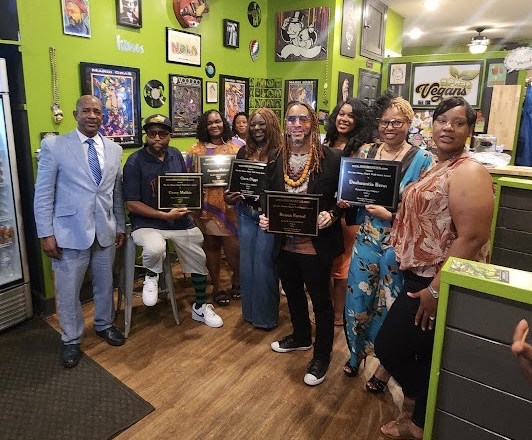
(BALTIMORE – March 30, 2026) — Fifteen years.
That’s how long it’s been since the first Black Wall Street Awards — then called the Black Capital Awards — launched at Busboys and Poets in Washington, D.C. From day one, Peggy Morris — my sister from another mister — was right there beside me. The United Nations would be our next stop.
Back then, I was just beginning to study Tulsa’s Greenwood District.
I became a sponge — listening to elders, gathering stories, connecting dots. One man told me about Mound Bayou, Mississippi — a thriving all-Black town founded by freedmen. Then I met Dr. Michael Carter of Black Wall Street USA in Oakland.
He told me something I have never forgotten:
“Brother Glover, if it ain’t got God in it, it ain’t Black Wall Street.”
At the time, I heard it.
Later, I understood it.
Every event starts with prayer. Period.
Because beyond Greenwood — its brilliance and its tragedy — Black Wall Street is not just a place.
It is a mindset. And a spirit.
It is discipline.
It is faith.
It is economic cooperation.
As I studied Black Wall Streets across the country — and later wrote I Am Black Wall Street (2021) — something hit me:
I grew up on Black Wall Street in Baltimore.
As the son of an undertaker, that’s all I saw — Black people doing business with Black people. Barbers. Florists. Seamstresses. Funeral directors. A full ecosystem.
I didn’t have the language then.
But I was living it.
From New York to Baltimore, Durham to Detroit, Atlanta to Chicago — wherever Black people built, there was a Black Wall Street.
Detroit had Black Bottom.
Chicago had Bronzeville.
Atlanta had Auburn Avenue.
And the builders? O.W. Gurley. Maggie Lena Walker. Annie Turnbo Malone. Then A.G. Gaston. Herman J. Russell. Reginald Lewis. Earl Graves. Today — Dave Stewart. Robert Smith. Oprah. Even into hip-hop.
It’s a continuum.
And it didn’t stop.
We have over $2 trillion in buying power.
So let’s be honest: any Black-owned business with a solid product or service should be able to survive — and thrive — if we choose it.
Instead, too often, we make everyone else rich.
That’s not oppression.
That’s misalignment.
And it’s time to correct it.
Through BMORENews and BlackUSA.News, we have built a multi-platform ecosystem dedicated to documenting, connecting, and advancing Black economic power — what we define as modern Black Wall Street.
Fifteen years later, this journey has been a blessing — traveling the East Coast, celebrating entrepreneurs, honoring builders, and documenting a living legacy.
And we don’t do this alone.
Our partners in each city are the engine — especially in New York and Atlanta, where the support has been exceptional.
So here’s to the next chapter:
Another 15 years.
Another 3,000 honorees.
Another nine cities.
I believe Joe Manns is smiling on us.
Special thanks to his son Josh, who crafts the awards, and to Lee Vaughan, my partner in bringing these ceremonies to Mobile, Tulsa, and Las Vegas.
Because this is not just an awards program.
This is institution-building.
This is economic alignment.
This is Black Wall Street.
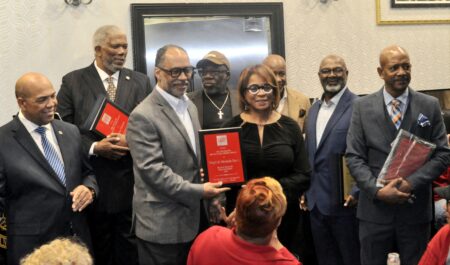
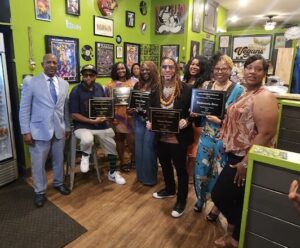
Established in 2011, the Joe Manns Black Wall Street Awards celebrate Black entrepreneurs, professionals, and allies. Ceremonies have been held in New York, Baltimore, Washington, D.C., Richmond, Atlanta, New Orleans, Mobile, Las Vegas, and Tulsa.