




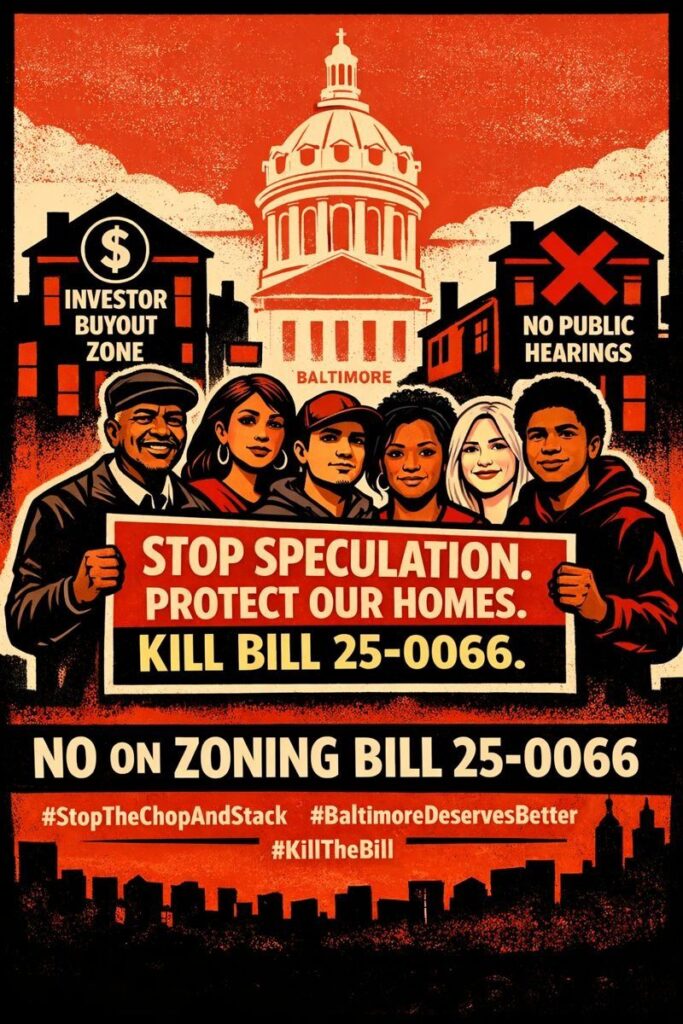
Mayor Scott’s zoning overhaul and Governor Moore’s statewide housing bill signal a major shift in how Maryland approaches development.
(BALTIMORE – March 15, 2026) – For months, Baltimore residents have been debating a controversial zoning proposal at City Hall that could allow single-family homes to be converted into multi-unit buildings.
But while that fight continues locally, a second housing plan moving through Annapolis could accomplish many of the same goals statewide.
Taken together, the proposals — one from Mayor Brandon Scott and another from Governor Wes Moore — represent one of the most significant shifts in Maryland housing policy in decades.
Supporters say the changes are necessary to address a growing housing shortage and expand housing options.
Critics warn the policies could reshape Baltimore neighborhoods faster than residents realize.
Baltimore may be entering the same housing transformation that reshaped cities across the country — but many residents are only now realizing how quickly it could happen.
The Mayor’s Housing Push
Introduced in 2025, Mayor Brandon Scott’s Housing Options and Opportunity Act seeks to expand Baltimore’s housing supply by allowing more units in neighborhoods traditionally zoned for single-family homes.
The centerpiece of the package, City Council Bill 25-0066, would permit homeowners or developers to convert certain single-family houses into duplexes, triplexes, or four-unit buildings by right in many residential districts.
Supporters say the measure could help attract new residents and reverse decades of population decline.
Baltimore has lost hundreds of thousands of residents since its mid-20th-century population peak, and city leaders argue expanding housing options could help the city grow again.
But critics fear the policy could encourage speculative investors to purchase homes and convert them into rental properties, potentially weakening homeownership in neighborhoods that have fought to rebuild after years of disinvestment.
Much of the detailed reporting on the zoning legislation and public opposition surrounding it has been led by The Baltimore Brew, which has closely followed the hearings, amendments, and debate around the mayor’s housing package.
Baltimore City Councilman James Torrence, representing Sandtown-Winchester, has emerged as one of the most vocal critics of the proposal.
During council hearings, Torrence warned the legislation could destabilize neighborhoods that have spent years working to restore community stability.
Parking Concerns
For many Baltimore residents, the debate over housing density is not theoretical — it is practical.
Baltimore’s iconic rowhouse neighborhoods were largely built before automobiles became common, meaning most homes rely almost entirely on street parking.
Critics note that a companion bill in the mayor’s housing package eliminates minimum off-street parking requirements for new residential development.
Supporters argue parking mandates increase construction costs and discourage transit use.
But residents worry the policy could simply mean more housing units without more places to park.
In neighborhoods where one house could potentially become four apartments, the question many residents raise is straightforward:
Where will the cars go?
Annapolis Enters the Debate
While Baltimore debates zoning changes locally, Governor Wes Moore has introduced legislation that could reshape housing rules across Maryland.
The proposal — House Bill 239 and Senate Bill 36, known as the Starter and Silver Homes Act of 2026 — aims to expand housing supply statewide by loosening traditional single-family zoning restrictions.
The legislation would allow smaller residential lots, permit townhouses in areas previously limited to detached homes, and make it easier to subdivide existing single-family properties into multiple housing units.
Supporters say the changes are necessary to address Maryland’s estimated 96,000-unit housing shortage and expand access to homeownership.
But critics say the bill could reduce local control over zoning decisions and allow development to move forward faster than communities can respond.
For Baltimore residents already concerned about Bill 25-0066, the statewide proposal raises another question: what happens if similar policies move forward in Annapolis even if the city bill changes or stalls?
The Transit Factor
Baltimore’s location along the Northeast Corridor rail line adds another dimension to the housing debate.
The city sits less than an hour from Washington, D.C. by train, making it increasingly attractive to commuters seeking lower housing costs than those found in the capital region.
Major redevelopment projects are already planned near Penn Station and the West Baltimore MARC station, where officials have promoted transit-oriented development tied to regional rail access.
The West Baltimore station area sits near the route of the infamous Highway to Nowhere, a highway project built in the 1960s that displaced thousands of residents in West Baltimore and left behind one of the city’s most visible scars.
Today, some residents worry redevelopment around the rail corridor could once again reshape surrounding neighborhoods.
Supporters see the rail connection as an opportunity to attract new residents and investment.
Critics fear that development pressure tied to regional commuting could arrive faster than existing communities are prepared to absorb.
Lessons From Other Cities
Baltimore would not be the first city to confront housing policy shifts tied to economic growth and regional commuting patterns.
San Francisco provides a powerful example.
As the technology sector expanded rapidly in Northern California, housing construction failed to keep pace with demand. The result was one of the most expensive housing markets in the country, forcing many long-time residents to relocate as prices surged.
Supporters of Baltimore’s housing reforms argue increasing supply now could help prevent similar affordability crises.
Critics counter that simply adding housing units does not necessarily guarantee affordability — particularly if most new construction serves the higher end of the market.
Community Voices Raising Concerns
Concerns about the proposed zoning changes have also been raised by several Baltimore advocates who have followed the issue closely.
Among the most outspoken has been Linda Batts, a community advocate and former Director of Equity for Baltimore’s Department of Public Works, who has been active in neighborhood organizing and zoning debates across the city.
Batts, who has filed a federal lawsuit alleging she was terminated after raising civil rights concerns inside the agency, has continued to speak publicly about housing policy and its potential impact on Baltimore communities.
Janet Allen, who first brought the issue to wider attention months ago, has also urged residents to examine the long-term implications of the legislation.
Carson Ward, a community advocate who lives in Reservoir Hill, has been active in raising questions about how the policies could affect Baltimore neighborhoods and community stability.
Meanwhile, Attorney Nichole’ C. Gatewood has contributed legal insight into the potential implications of the zoning proposals and related housing legislation.
Allen, Ward, and Gatewood have each appeared on the Emmy-nominated Doni Glover Show, where the issue has been discussed as part of a broader conversation about housing policy and neighborhood stability.
Baltimore’s Long Housing History
Few American cities have a housing history as complex as Baltimore’s.
In 1910, Baltimore became the first city in the United States to pass a residential segregation ordinance, signed by Mayor J. Barry Mahool.
The law prohibited Black residents from moving onto majority-white blocks.
Two Black attorneys, George McMechen and W. Ashbie Hawkins, helped lead the legal fight against the ordinance.
Baltimore was also home to one of the largest populations of free Black residents in the United States prior to the Civil War, shaping the city’s long-standing identity as a center of Black life and culture.
Yet housing policy has repeatedly reshaped Baltimore’s neighborhoods.
Uneven Impact Across Neighborhoods
Another question raised by critics is where these zoning changes will have the greatest impact.
Some long-established neighborhoods — including areas shaped by historic covenants or unique zoning protections — may see little change, while other parts of the city could experience far more redevelopment pressure.
Critics say that raises an important issue: whether density policies designed to expand housing supply will be applied evenly across Baltimore, or whether certain communities will bear a disproportionate share of the changes.
What Comes Next
Both the city and state proposals remain in the legislative process.
Baltimore’s Bill 25-0066 continues to move through the City Council, while the Starter and Silver Homes Act remains under consideration in Annapolis committees.
Amendments, hearings, and votes in the coming months will determine whether the legislation advances — and in what form.
The stakes are significant.
These policies could either open the door to reinvestment and mixed-income neighborhoods — or accelerate development pressures that reshape communities faster than long-time residents can adapt.
For a city whose history has often been shaped by housing decisions, the question many residents are now asking is simple:
Who will Baltimore’s next wave of development ultimately be built for?
_______________________________________________________________________________
RELATED STORIES